

A medicine bag that can enter China has not automatically passed the rules for your next flight. Before travelling, check the medicine’s Chinese status and personal-use quantity with the competent authority, then check cabin carriage with the actual airline and airport. These are separate decisions, even when the medicine stays in the same bag.
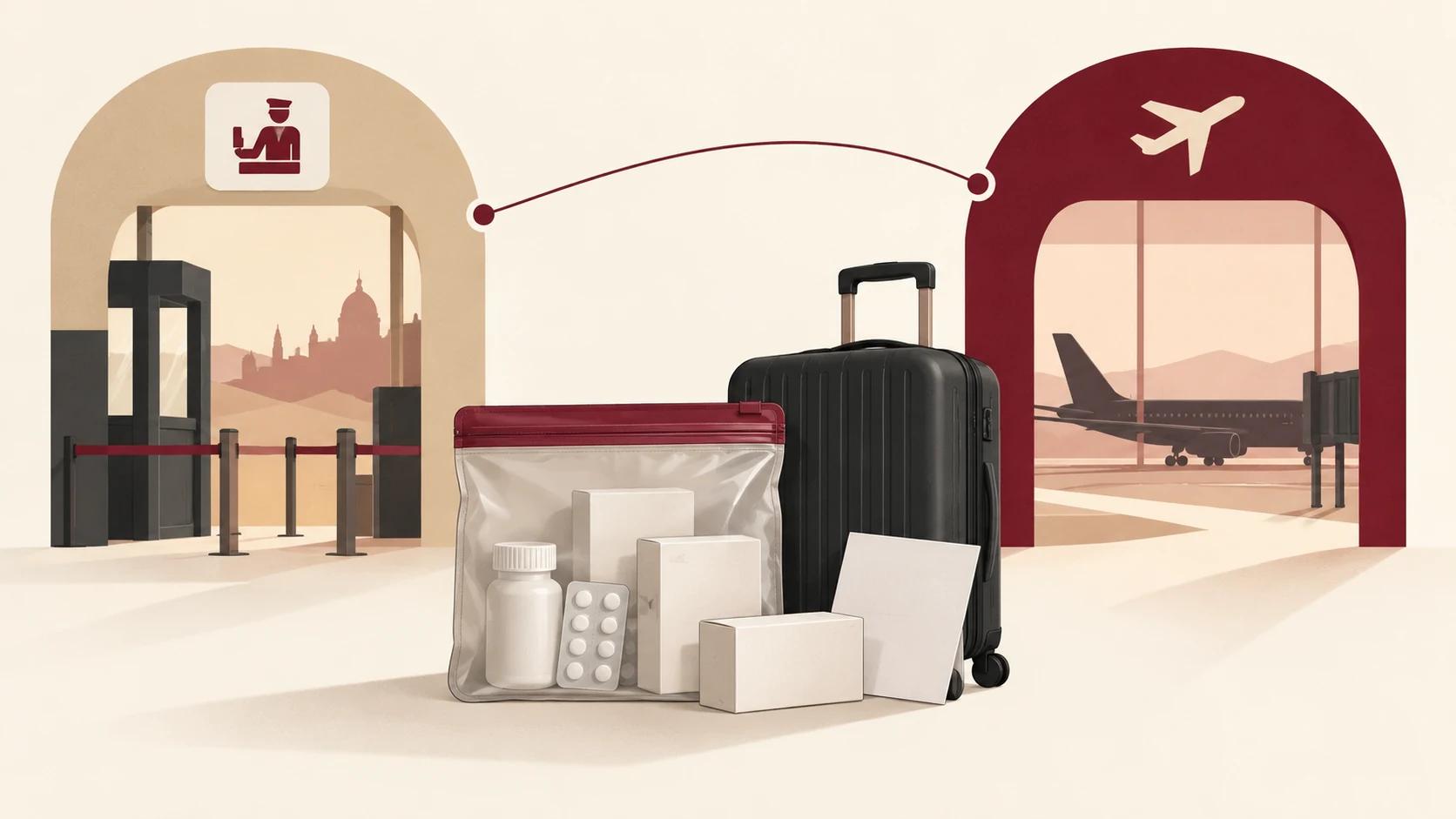
For ordinary medicines, current Chinese guidance uses a reasonable quantity for personal use. Narcotic and psychotropic medicines have additional conditions. Necessary liquid medicine also has a specific aviation screening pathway; treating it exactly like shampoo can lead to the wrong packing decision. This guide helps you prepare those checks for a visit to China, including an onward journey towards Yiwu. It does not approve a particular medicine or change your treatment.
Key takeaways
- Identify the active ingredient, strength and form; a familiar brand or a foreign prescription does not establish Chinese permission.
- Separate ordinary personal-use medicine from narcotic or psychotropic categories before deciding what quantity to carry.
- Keep readable pharmacy packaging and supporting documents with the medicine, ready to show privately.
- Check the actual onward flight: customs entry and cabin security answer different questions.
- Necessary liquid medicine is subject to screening, rather than an automatic entitlement to take any bottle into the cabin.
- Resolve an unsuitable travel arrangement with the authority, carrier and prescribing team; do not improvise a medicine change.
 Watch: TSA Cares — Traveling With Medication
Check the ingredient and personal quantity first
Start with the product you actually have, not a general list of medicines that other travellers carried. Record the generic or active-ingredient name, brand, strength, dosage form and total quantity. Include each ingredient of a combination product. Use that description when asking China Customs or the relevant Chinese embassy or consulate about your intended journey. Your prescriber or pharmacist can help identify the product accurately; the authority answers the entry question.
The UK government’s current China health advice warns that medicine status can differ between countries, some products may be unavailable, and others may not be allowed into China. Its advice is to check before travelling. A prescription is useful evidence of medical need, rather than a substitute for that check.
| Verified status | What the official guidance says | Your preparation outcome |
|---|---|---|
| No narcotic or psychotropic substance | Small, reasonable quantities for personal use remain subject to customs supervision. | Explain the personal supply using the medicine, prescription and trip details; avoid assuming a fixed allowance. |
| Narcotic or Category I psychotropic medicine needed for treatment | The personal-treatment route refers to a diagnosis certificate, identity document and the maximum quantity permitted on a single prescription. | Confirm the exact product and applicable quantity with the authority before packing it under that route. |
| Category II psychotropic medicine, or status not yet established | The customs FAQ says Category II prescribed quantities may be extended where appropriate; it gives no universal traveller allowance. | Obtain a case-specific answer. Do not infer permission or a number of days from another visitor’s experience. |
These distinctions come from the Chongqing government’s customs-sourced guidance of 29 June 2026. A ten-day trip does not make ten days of every medicine automatically admissible. Likewise, a large prescription issued abroad does not by itself establish the permitted Chinese quantity.
There is also an important distinction between a patient and a medical professional carrying supplies. Article 44 of the current controlled-drug regulation, amended in December 2024, sets out the personal-treatment provision and a separate certificate requirement for medical personnel carrying small quantities for medical purposes. Do not copy the professional-supplies paperwork into a patient checklist or assume a foreign doctor’s letter is that official certificate.
Pack a readable medicine set
Once the status and quantity are resolved, make the physical bag easy to explain. NaTHNaC’s medicines-and-travel guidance recommends original pharmacy packaging, a prescription copy and a prescriber’s letter identifying medicines by generic name. It also advises checking airline arrangements for injectable medicines and storage needs before travel. These are general preparation measures, not Chinese import permission.
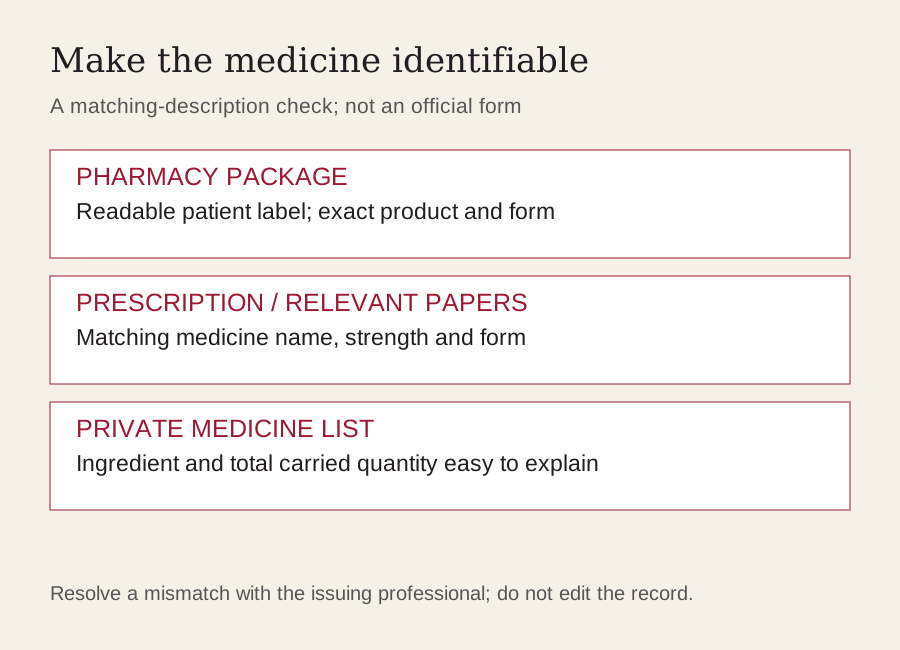
Keep the label readable instead of making an unmarked mixture of tablets your only identifiable supply. Put the relevant supporting papers where you can retrieve them with the medicine. A private offline copy can help if an internet connection is unavailable; retain the underlying original documents as required. Check that the medicine name, strength and form agree across the label and papers. Ask the issuing professional to resolve a discrepancy rather than editing the medical document yourself.
For a controlled medicine, use the diagnosis and identity documentation required for the applicable route. For other medicines, bring the supporting material appropriate to the product and the official answer you received. An English or Chinese explanation may help communication, but translation does not turn an otherwise restricted product into an authorised one. If the hospital separately requests translated records for care, use its own requirements; our medical-record translation guide addresses that different task.
Temperature-sensitive medicine needs a practical plan based on its own instructions. Ask the pharmacist or prescribing team about storage during the journey, and ask the carrier about any cooling equipment. Do not assume a hotel minibar, airport facility or aircraft crew can provide the required conditions. Keep a storage question separate from a customs classification question: a lawful product can still need arrangements that the proposed journey cannot provide.
Apply the liquid-medicine exception to the onward flight
The next checkpoint may happen after you have already entered China. If you transfer to a domestic flight, recheck that sector rather than relying on what was accepted at your overseas departure airport.
The Civil Aviation Administration of China’s passenger guidance distinguishes general liquid rules for domestic and international or regional flights. It also says liquid medicines needed by patients during air travel may be carried after security examination. That specific medical pathway matters: the ordinary international 100 ml container rule does not alone decide whether a necessary medicine can travel in the cabin.
| Question | Who answers it? | What does not settle it? |
|---|---|---|
| May this ingredient, form and quantity enter China for my personal treatment? | The competent Chinese authority, with customs review at entry. | A foreign prescription, a travel blog or an airline accepting the bag. |
| How will the necessary medicine and any equipment pass this flight’s security and cabin requirements? | The actual carrier and airport security, applying the relevant procedure. | Customs entry permission or a previous airport’s decision. |
| Can the proposed journey meet the medicine’s handling requirements? | The prescribing team or pharmacist explains the requirements; each transport or accommodation provider confirms its own arrangements. | A general promise that the hotel is “medical friendly”. |
For a concrete carrier example, China Eastern’s published carry-on page, section 3(3), says liquid medicine necessary for patients with diabetes or other illnesses during air travel can be carried after examination at security. The page also warns that airport security restrictions may change. It is not a blanket promise for every bottle, amount, needle, cooling pack or device.
Give the actual operating carrier the flight details and the practical requirement before travelling. Ask what quantity must remain accessible, what supporting documents it needs, how to present the medicine at screening, and whether any separate equipment needs an arrangement. Keep the answer for that sector. If you change airline or airport, check again. Do not decant a medicine or alter its storage merely to fit an ordinary toiletry rule without professional guidance.
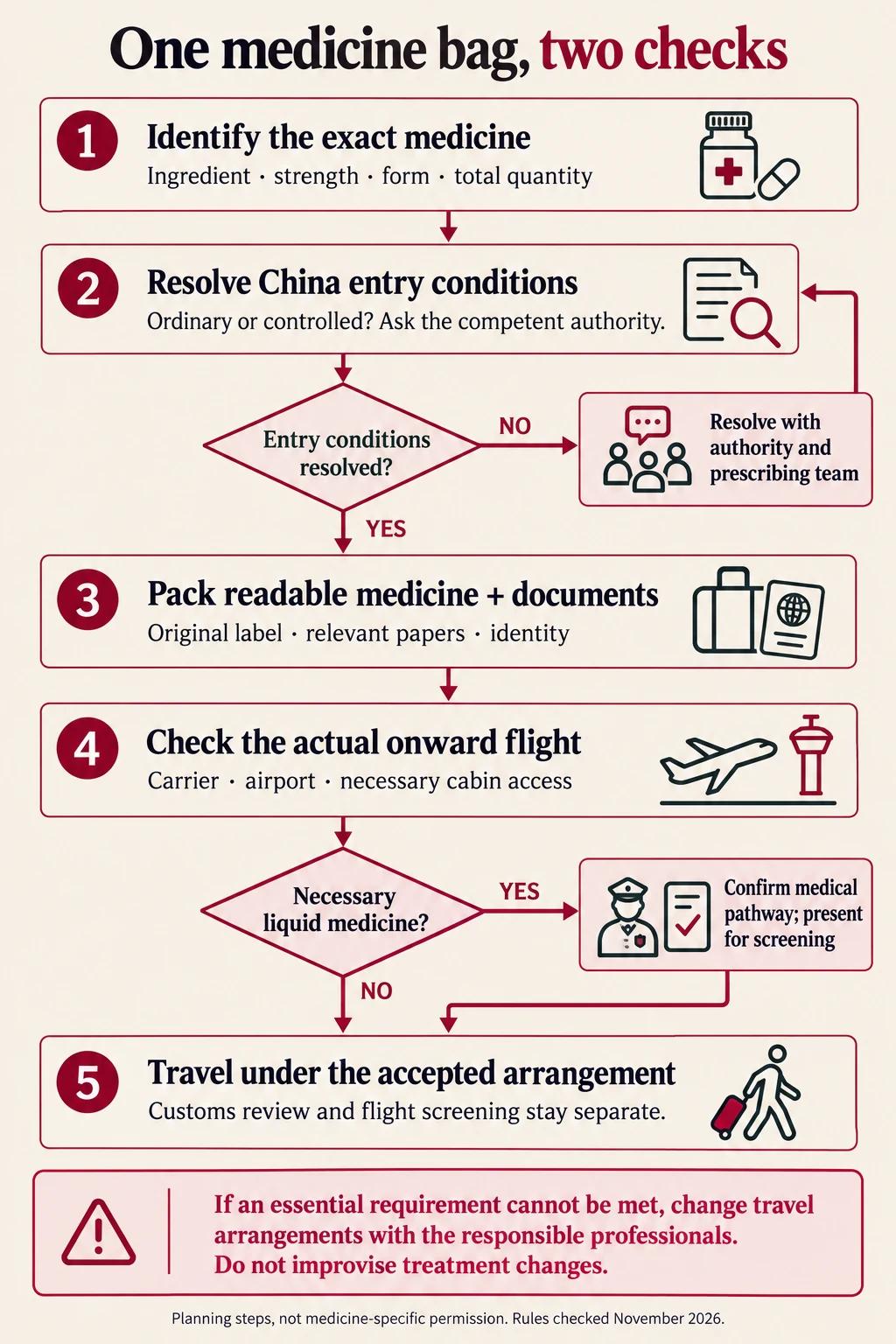
- Identify exact ingredient, strength, form and total carried quantity.
- Resolve ordinary/controlled entry conditions with competent authority; unresolved returns to authority/prescribing team.
- Pack identifiable medicine with relevant supporting papers and identity.
- Check actual onward carrier/airport and necessary cabin access.
- If necessary liquid, confirm medical pathway and present for screening; all travel remains under accepted arrangements.
Two finished travel choices
Example 1: a ten-day visit with ordinary tablets
Fictional planning example. A visitor plans ten days in China, including Yiwu. Assume the competent authority has confirmed that the exact tablet product is outside the narcotic and psychotropic categories, and the visitor has resolved the appropriate personal-use quantity with the relevant professionals and authority. The trip length is context, not a permission threshold.
The visitor keeps the medicine in its patient-labelled pharmacy packaging, puts the prescription and medicine list beside it in accessible hand baggage, and retains the ingredient and quantity information for customs. The chosen entry plan includes proactive declaration and showing the documents when requested. The onward flight still has its own screening step. The result is an identifiable personal medicine bag and a clear declaration plan, rather than loose tablets supported only by a forum comment.
Example 2: necessary liquid medicine on a domestic connection
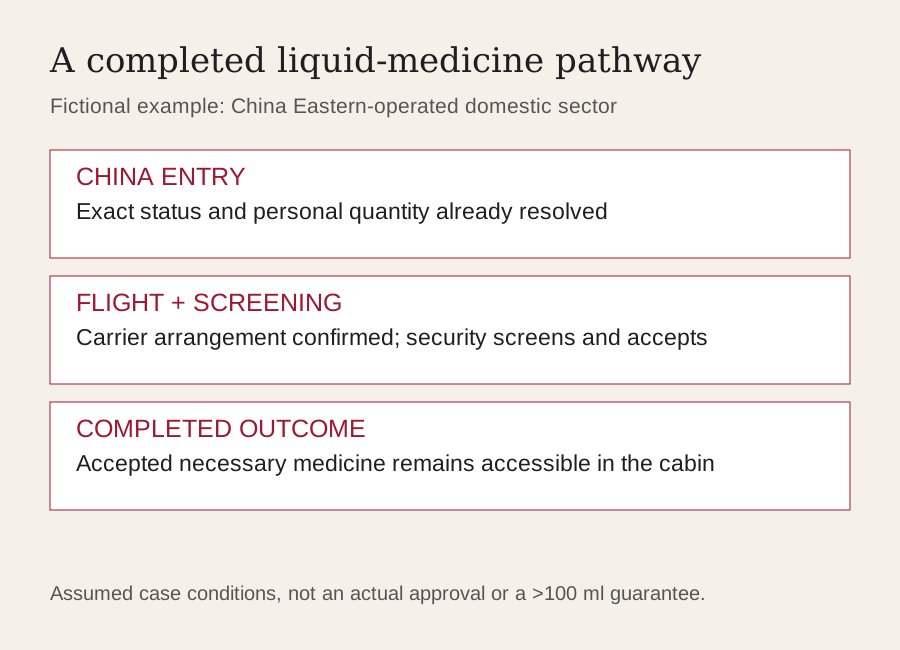
Fictional illustration, not an actual passenger approval. Assume the medicine’s Chinese entry status and quantity have been resolved. The onward domestic flight is operated by China Eastern. For this example, assume the carrier has confirmed the particular cabin arrangement and documentation, and airport security subsequently examines and accepts the necessary liquid medicine under the medical pathway.
The completed outcome is that the accepted necessary medicine remains accessible in the cabin, with its label and supporting documents. The traveller presents it for the medical screening procedure instead of automatically discarding it as an oversized toiletry. Nothing in this example approves a cooling pack, needle or device; each additional item needs its own applicable check.
Change one assumption and the decision changes. If the required medicine cannot be carried or handled as needed on the proposed sector, the traveller works with the prescribing team, authority and carrier to arrange a workable journey before committing. That may mean changing travel timing or transport arrangements. It does not mean skipping doses, substituting a product or hiding the medicine. A different transport mode also needs its own checks.
At customs and after a changed itinerary
Shanghai Customs’ answer updated on 14 October 2026 advises carrying supporting prescriptions, medical records or diagnosis certificates and proactively declaring medicines to customs officers at the port. Its example concerns a visitor asking about a controlled medicine; it does not grant everyone carrying that brand a personal approval.
Have the medicine and papers ready for the officer’s review. Do not plan around an online assurance that nobody will inspect the bag or that a particular lane guarantees clearance. Allow the declaration process to happen before treating your onward arrangements as completed.
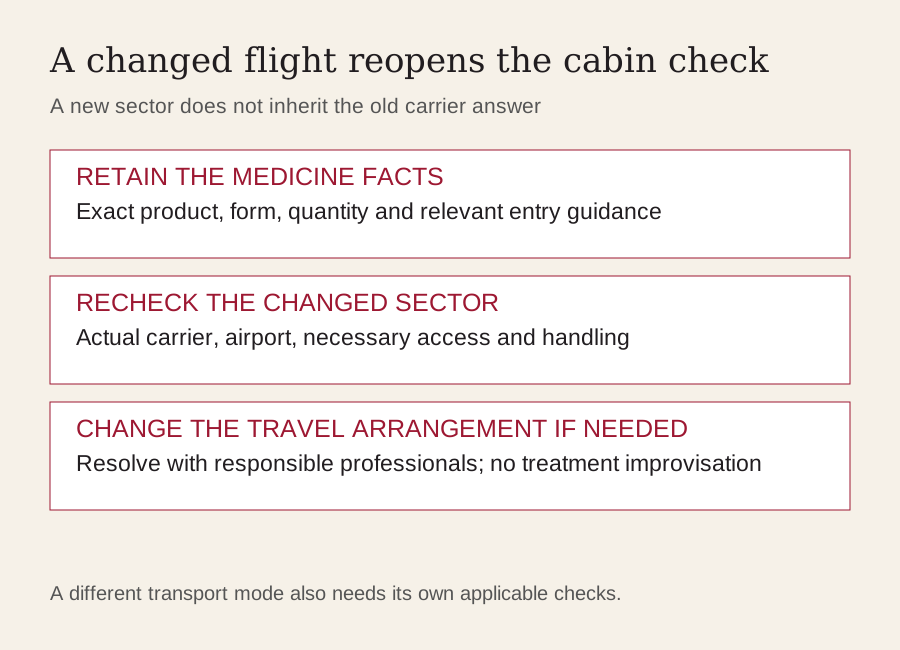
Revisit the relevant check when the quantity, route or handling arrangement changes. A longer multi-country journey may involve medicine intended for later destinations too; explain the full itinerary when asking the authority, and check the other countries separately. If a disruption threatens access to essential medicine, contact your treating team or an appropriate medical provider promptly. Do not assume a local pharmacy will have the same product.
For help organising transfers, dates or a stay around confirmed requirements, Discuss the practical travel arrangements around your visit. NiceYiwu’s form is for logistics. Keep diagnoses, prescriptions, clinical records and identity documents out of that enquiry; send sensitive information only through the appropriate official or clinical channel.
Conclusion
Resolve the medicine’s status and quantity first, prepare a readable personal supply, then confirm the separate flight and screening arrangement. Keep the answers attached to the actual product and journey. If an essential requirement cannot be met, settle the travel change with the responsible professionals before leaving.
FAQ
Does my foreign prescription guarantee that the medicine can enter China?
No. It supports your medical need, but Chinese status, quantity and customs review still apply. Confirm the exact ingredient and product before travelling.
Is there a standard number of days of medicine I can bring?
The cited guidance gives a reasonable personal-use principle for ordinary medicines and separate controlled-medicine conditions. It does not establish one allowance for every traveller or product.
Must necessary liquid medicine always fit a 100 ml bottle?
Do not decide from the ordinary liquid rule alone. Chinese aviation guidance provides a screened pathway for necessary patient medicines; confirm the actual carrier, quantity and airport procedure.
Can NiceYiwu obtain medicine approval or arrange treatment?
NiceYiwu accepts practical travel-logistics enquiries. It does not classify medicines, provide customs permission, prescribe, or guarantee clinical appointments.
Research-based guide. Visitor reports are attributed; this article does not imply an in-person test.