



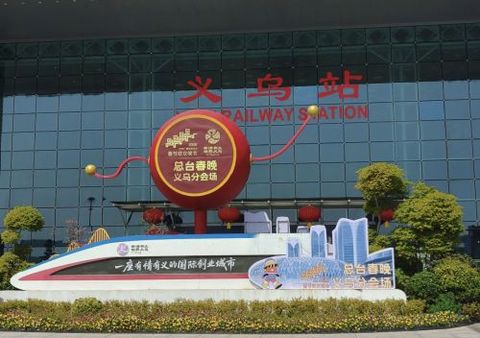
For a wheelchair journey to Yiwu, complete the railway assistance request for each train leg, then separately confirm the exact station side and meeting point with your driver or companion. “Yiwu station” alone is too vague: the new station building opened on 9 October 2026 with north and south access. An accepted railway request and a driver waiting at the other side still leave an unfinished handover.

This guide helps an overseas visitor connect the rail journey to a Yiwu itinerary. Its practical output is a private, two-part handover record: what the railway has accepted, and what the person meeting you has actually confirmed. It is researched guidance, not a wheelchair route inspection or an accessible-vehicle booking service.
A current station context video
Chinagoods published this new Yiwu Station introduction on October 15, 2026. It provides station context, not confirmation of an accessible route, railway assistance or your agreed north/south handover.
Open the related Yiwu Station video
Watch the Chinagoods station introduction on YouTube. Playback has not been manually verified.
The new station changes what a pickup confirmation must say
The Ministry of Transport’s 12 October report confirms the 9 October opening and north/south entry arrangement. China Yiwu Net’s reporting from opening day describes entry and exit on both sides, including the newly opened north exit. That is a reason to refresh old pickup instructions.
Neither report establishes a continuously step-free route for your particular chair, train and meeting point. References to escalators, lifts or easy transfers do not establish doorway fit, platform arrangements or an agreed assisted route. The local reporter’s fast walking observation is not a wheelchair journey time. Opening-day entrance hours also need current confirmation for your travel date.
The useful question is therefore more specific than “Is the station accessible?” Ask the railway contact which exit and meeting point can be used for this arrival, then ask the person collecting you to repeat the same location. Do not pick the north or south side because a map thumbnail looks closer to your hotel. The workable point depends on the actual route and assistance arrangement.
A vehicle drop-off area and an arrival pickup point can also be different places. If someone sends an entrance pin, ask whether they mean the place to leave a departing passenger or the place where they will meet an arriving one. Keep that distinction in the written record rather than trying to resolve it after leaving staff.
Establish the railway request before joining it to a transfer
12306’s current special-passenger instructions cover travellers needing special care, including those dependent on assistive devices for movement. Registered users may apply for themselves or passengers. The application requires valid ticket details, actual stations and train, needs and relevant valid supporting material. Identity must match the ticket; railway staff review eligibility and evidence and may refuse an unsupported request. Ask the official channel what material and format it accepts; foreign-document acceptance is not established here.
Submit online at least six hours before departure. With less than six hours, apply at the actual departure station no later than 60 minutes before departure. Request each connecting leg separately. These are application deadlines, not a suitable arrival-time budget for every traveller. Assistance acceptance does not reserve a disability-quota ticket or establish permission to remain in your own chair on board.
Keep the acceptance response available privately. “Submitted” and “accepted” are different entries in your planning record. If an answer does not address a condition you depend on, such as remaining in your chair, ask for that exact arrangement rather than extending a general acceptance to cover it. Where it remains unresolved, keep the journey provisional and check the live booking channel’s change or refund terms before committing further money.
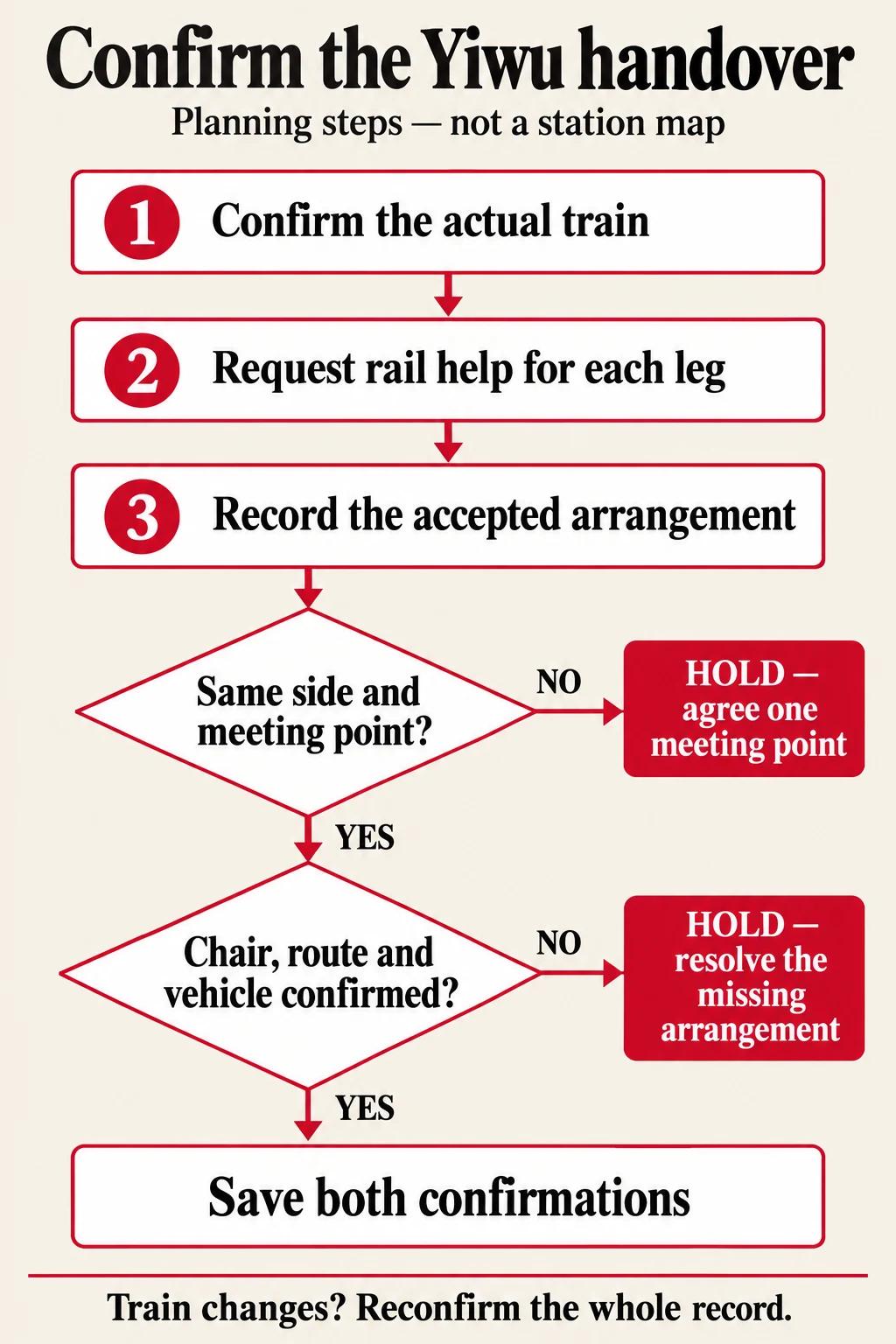
- Confirm actual train
- Request rail help separately for each leg
- Record accepted railway arrangement
- Compare north/south side and exact meeting point with collecting person
- Mismatch: HOLD until one point is agreed
- Confirm chair, route and vehicle/companion arrangement
- Any missing condition: HOLD and resolve with responsible contact
- Save both confirmations; train change reopens entire record
Build a two-part Yiwu handover record
Use one record for each Yiwu arrival or departure. The railway part should say what has been accepted; the local part should say who will meet you and what they can actually do. Copying a map pin into both parts is useful only if both contacts understand the same side, level and landmark.
Leave an unanswered field marked unconfirmed. A blank can look like an omission; “unconfirmed” makes it a task someone must resolve. Record who gave the answer and when, so a later train change does not leave an old arrangement looking current. You can keep this as a plain private note; no new app or public upload is needed.
| Record field | Railway confirmation | Driver or companion confirmation |
|---|---|---|
| Journey identity | Actual date, train and Yiwu arrival or departure; request status. | Same date and train; who checks for changes. |
| Station side | Exact north/south side for the agreed handover. | Repeat that side explicitly, not just “station.” |
| Meeting point | Level, landmark and where railway help ends. | Same landmark; where the person waits and how you recognise them. |
| Physical arrangement | Questions resolved for the particular chair, route and train. | Chair description, loading method, transfer boundary and vehicle fit agreed. |
| Contact and failure | Reachable official contact and instruction if the point changes. | Reachable named person and response if the agreed point cannot be reached. |
| Outstanding item | What remains unconfirmed and who must answer. | Same unresolved issue acknowledged before relying on pickup. |
Describe functional needs rather than sending a medical history to a driver. Useful details include whether the chair folds, its outside dimensions and weight, whether it is powered, and whether the traveller can transfer safely. Ask the provider to confirm its actual loading and seating arrangement against those details. “Large car” does not answer whether an occupied wheelchair can travel in it.
If the traveller must stay in the chair, make that a condition of the plan from the first enquiry. Do not let a driver’s assumption that the chair will go in the boot stand in for an agreed arrangement. Equally, a confirmed vehicle does not settle the route from the railway handover point to that vehicle.
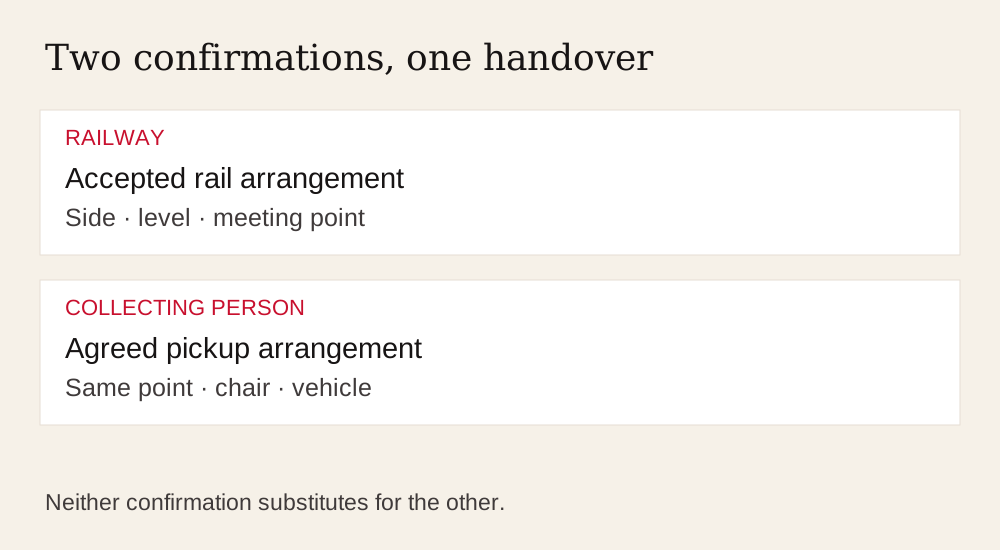
Worked example: railway says south, driver says north
Hypothetical planning example: a visitor has an accepted rail assistance request with a south-side meeting point. The driver’s message says north side. These are teaching assumptions, not a report of an actual passenger or a station-tested route.
The record fails at the location field even though both people have replied. Sending the traveller across the station would introduce an unconfirmed route and could move them beyond the agreed railway assistance. Instead, identify the mismatch while both contacts can still adjust their instructions. Ask which single meeting point can be used, who will accompany the traveller to it and whether the vehicle can meet the resulting arrangement.
| Changed fact | Decision | Next action |
|---|---|---|
| Railway: south. Driver: north. | HOLD the local handover. | Obtain one shared point and an agreed route to it. |
| Driver changes to south; vehicle fit still unanswered. | HOLD the vehicle arrangement. | Resolve loading, seating and the traveller’s transfer boundary. |
| Both confirm the same point and usable physical arrangement. | Record the handover as confirmed for that journey. | Save both acknowledgements and recheck after changes. |
| Only the train changes; old meeting messages remain. | Reopen confirmation. | Check the railway response and local pickup against the new train. |
Countercheck: changing just “north” to “south” in the driver’s reply removes the side conflict. It does not answer vehicle fit or the route to the vehicle. This is why the record has separate fields: one reassuring answer cannot silently clear every remaining condition.
If the problem appears on arrival, stay at a safe staffed point and explain the conflicting instructions. Ask staff and the collecting person to agree the next movement before proceeding. Do not turn a deadline or a waiting driver into a reason for unplanned lifting, stairs or an unsupported transfer.
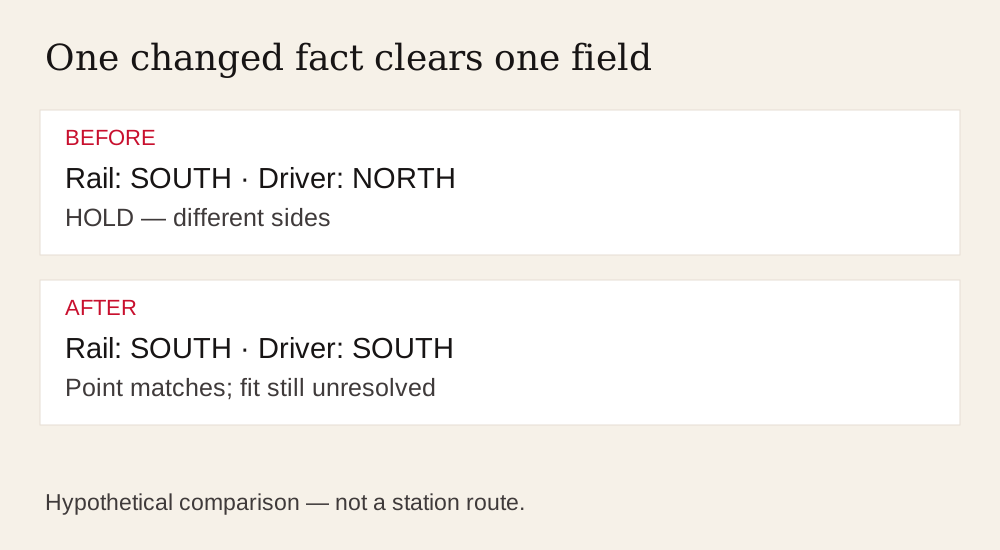
Send questions that each contact can actually answer
For the railway contact: “For train ___ on ___, which Yiwu side, level and landmark is the agreed meeting point? Where does the accepted help end? What remains to be confirmed for the chair and the traveller’s transfer needs?” Keep official ticket and supporting-material submissions within the railway channel.
For the driver or companion: “Please repeat the station side and meeting landmark. Can you meet us at that exact point? Here are the chair’s practical dimensions and transfer requirements. Please confirm the vehicle and loading arrangement, and who to contact if the point changes.” A companion’s agreement should describe their actual role; presence alone does not establish lifting capability.
Connect this record to your Yiwu travel plan before fixing the rest of the day. A confirmed handover gives you a defined arrival task to organise around; it does not supply a universal station buffer or guarantee a sightseeing start time.
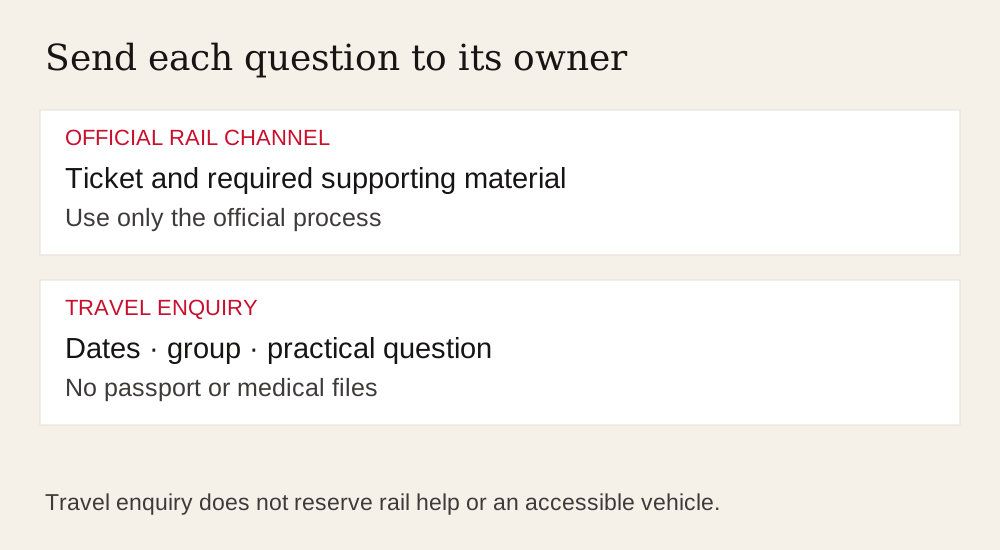
Ask about your Yiwu itinerary and transfer questions. The existing enquiry asks for dates, group, interests and language. Explain the practical question without passport numbers or medical files. Scope, availability and any fee require separate confirmation; this enquiry does not reserve railway assistance or an accessible vehicle.
Conclusion
Before relying on the journey, check the exact train, accepted railway arrangement, Yiwu side, shared meeting point and vehicle or companion plan. Name the owner of every unresolved field. If the side changes, repeat the point confirmation; if the train changes, reopen the whole record. The useful result is two people agreeing to the same workable handover, with the traveller’s actual needs preserved.
FAQ
Does a confirmed driver mean the rail handover is ready?
Only when the driver and railway contact agree on the same usable meeting point and the actual boarding arrangement is confirmed. A vehicle booking alone leaves the station handover unresolved.
Can I use an old photo to identify the meeting point?
Use it only as a question for the current contact. Ask for the present side, level and landmark; an older station photograph cannot establish today’s usable route.
Should I send medical records to NiceYiwu?
No. Keep identity and medical evidence out of the travel enquiry. Supply required supporting material only through the official railway process where requested.
What changes if my train is changed?
Reconfirm the railway arrangement and the local handover. Replace the train details, check the actual side and meeting point again, and obtain a fresh acknowledgement from the driver or companion.
By Justin · NiceYiwu. Public sources checked 31 October 2026 (Shanghai). No station route, train or vehicle was field-tested for this guide.
Research-based guide. Visitor reports are attributed; this article does not imply an in-person test.
Sources & checks
- New Yiwu station building opened 9 October 2026; north/south entry organization. · Checked 2026-10-30
- Opening-day local firsthand reporting describes north/south entry and exit including north exit. · Checked 2026-10-30
- Current visible clauses 1–6: registered applications; category; conditional assistance; valid ticket/material/identity and review; 6h online / under6h station no later60min; separate legs. · Checked 2026-10-30
- Travel enquiry actual anchor and dates/group/interests/language fields, separately confirmed service scope/availability/fees. · Checked 2026-10-30