



You can include Yiwu in a 240-hour visa-free transit visit if your passport, complete international route, entry port, permitted travel area and onward departure all meet the policy.
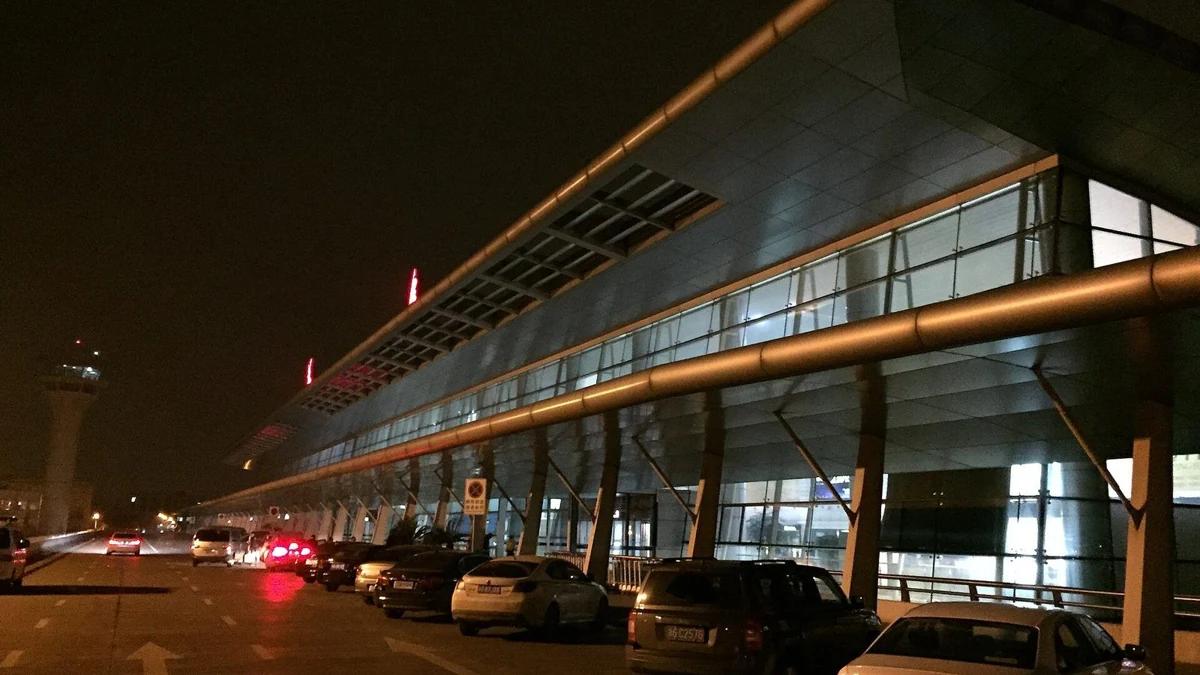
Yiwu is inside Zhejiang’s permitted area; reaching Yiwu by train does not establish eligibility to enter China. Check whether a different visa-free policy already applies to your passport, then test the whole journey before committing to the Yiwu part.
This is a route-planning guide based on official information checked on 26 October 2026. Immigration authorities decide entry. A short stay or a booked hotel alone does not qualify a traveller for transit entry.
Key Takeaways
- Check your applicable entry policy first: ordinary visa-free entry and visa-free transit have different conditions.
- The current NIA transit list covers ordinary passports from 57 countries. Check every traveller individually.
- Write the journey as country or region A → mainland China → country or region C. A and C must differ.
- The official permitted-area table includes all of Zhejiang, including Yiwu, and lists Yiwu Airport and Hangzhou Xiaoshan International Airport.
- Carry confirmed onward travel and check the actual immigration deadline; the published counting rule starts at midnight after entry.
- If flights or destinations change, reassess the route before relying on the old plan. Ask the carrier and immigration about unresolved conditions.
 Watch the background report: CGTN, March 2025
Historical background about the policy expansion. Use the current official rules linked below for eligibility, ports and permitted areas; this report does not establish today’s country list.
Open the original CGTN video on YouTubeStart with the entry policy for your passport
“China is visa-free” leaves out the condition that matters to your booking. Some travellers qualify under a mutual visa-exemption agreement or China’s unilateral visa-free arrangements. Others may rely on transit, or need a visa. The NIA’s conditions explicitly say that applicable mutual or unilateral exemption provisions take precedence. Start with your nationality, ordinary-passport status, purpose and proposed dates, rather than selecting the ten-day option because someone else used it.
Read the NIA unilateral visa-exemption information and the Chinese embassy or consulate guidance applicable to your passport. That NIA list is dated 17 February 2026; do not assume that a list by itself answers every condition or future travel date. If you will use transit, check the current NIA transit policy and country list, updated 20 August 2026.
Do this separately for a mixed-nationality family or group. A companion’s eligibility does not answer yours. The current transit page specifies ordinary passports; the NIA conditions also require a valid international travel document with at least three months’ validity and the right to enter the onward country or region. A destination visa or entry authorisation, when required, is therefore part of the journey check. Treat an unusual document, previous immigration issue or unclear eligibility as a question for the authorities before purchase.
Test the international route, including connections
The transit condition concerns the places on either side of mainland China. The Chinese Embassy in Canada’s explanation says that the departure and destination must belong to different countries or regions. Your passport nationality is a separate eligibility question. Changing the Chinese city does not turn a return journey to the same country into transit to a third place.
Use the examples below only to test that route condition. They assume direct international legs as written, an eligible traveller and compliant documents, ports, areas and dates; they are not flight offers or entry approvals.
| Journey as booked | Route finding | What still needs checking |
|---|---|---|
| United States → Shanghai; Yiwu visit; Hangzhou → Japan | A and C differ: passes this route test. | Passport, actual flights, port, areas, onward entry rights and departure time. |
| United States → Shanghai; Yiwu visit; Hangzhou → United States | A and C are the same: fails the transit route test. | Check another applicable entry policy or visa before relying on this trip. |
| Japan → Shanghai; Yiwu visit; Shanghai → Japan | A and C are the same, even with different Japanese cities. | A different Chinese arrival or departure airport does not solve this condition. |
Write down every flight sector, including connections, instead of abbreviating a multi-stop booking to “home → China → holiday.” An overseas connection can change the places immediately adjoining mainland China; a domestic connection can change where you complete immigration. Ask the operating carrier to check the actual itinerary when either is unclear. Air China’s passenger guidance specifically directs travellers with domestic intermediate stops to confirm the immigration-processing location, transit area and time conditions with immigration authorities.
The useful distinction is between a route that visibly fails and one that may satisfy the rule. A same-country return is a reason to stop relying on transit. A different-country onward ticket is a reason to proceed to the remaining checks, not a reason to skip them. Avoid treating a booking confirmation, route-checker result or anecdote as the border decision.

Place Yiwu inside the permitted journey
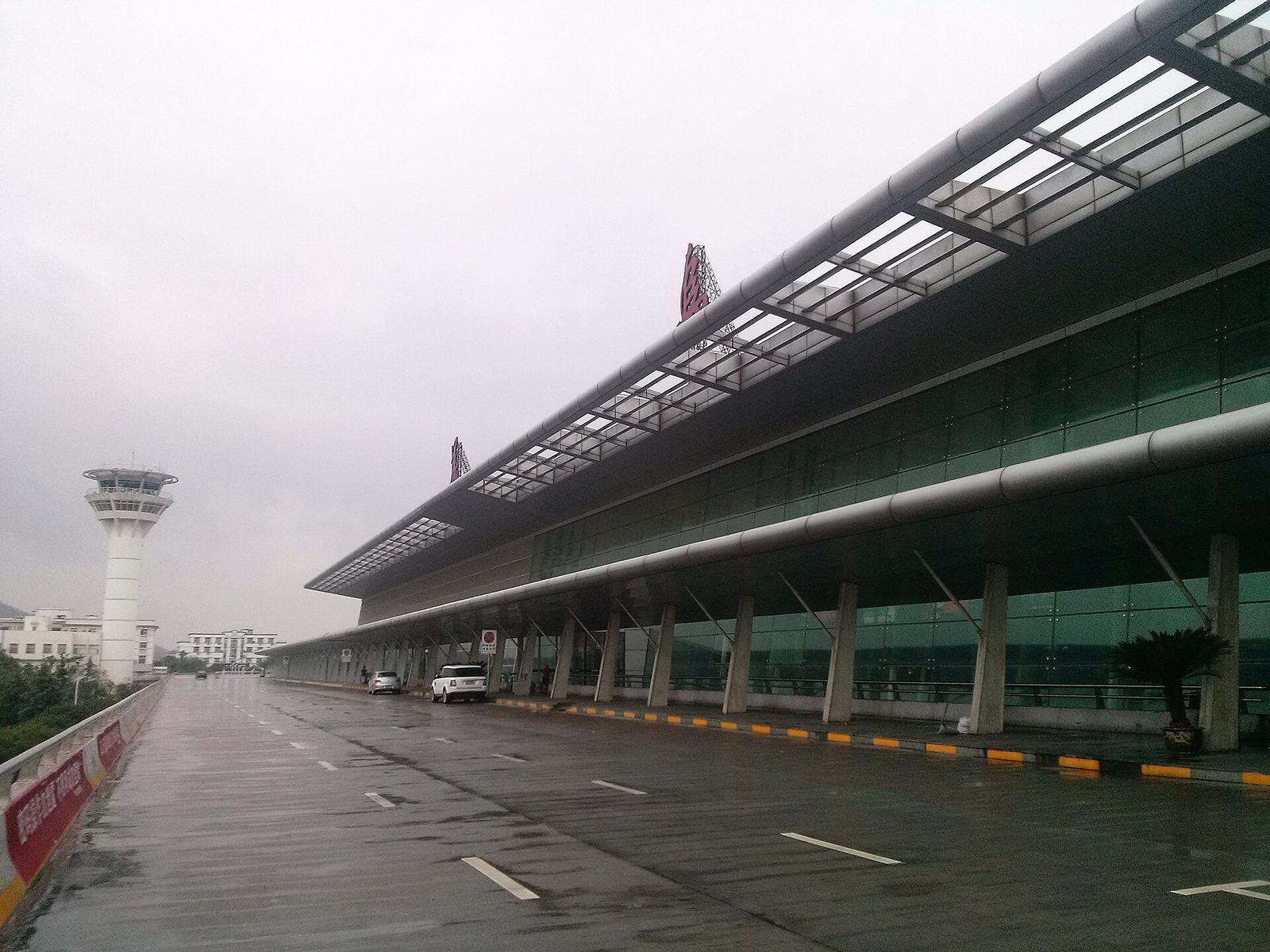
The current NIA table separates eligible ports from permitted stay areas. They answer different questions. A port is where a traveller uses the entry or exit arrangements; the area determines where the visit may take place after admission. Zhejiang is listed as a whole-province permitted area. The Zhejiang port entries include Hangzhou Xiaoshan International Airport and Yiwu Airport. Shanghai is also a permitted area, with Pudong and Hongqiao airports listed.
For a Shanghai or Hangzhou arrival followed by Yiwu, this makes Yiwu an eligible geographic component of the plan. It does not mean that every transport service is available, that every airport has a flight to your onward destination, or that all of China is open to the visit. Read the official table of ports and permitted areas for every stop. Several other provinces have specified cities or regions rather than province-wide permission.
Separate the international plan from the local one on paper. First identify the port where you will actually enter mainland China and the port for your onward departure. Then list Yiwu, hotels and side trips beneath them. A domestic train ride to Yiwu stays within the mainland part of that record; it neither creates a new international transit nor starts a fresh clock. If you propose a detour beyond Zhejiang or Shanghai, check the exact place against the current table before adding a non-refundable hotel.
Once those boundaries are clear, use our Shanghai and Hangzhou arrival guide for the separate station and airport transfer decision. Build sightseeing around the time left after the international arrival and departure movements. The Yiwu travel planning hub helps turn that available time into a visit without making the immigration decision for you.
Work backwards from the departure deadline
The NIA’s published application conditions state that the visa-free period is calculated from 00:00 on the day after entry. They also require confirmed onward arrangements within the permitted period and temporary entry formalities with immigration. Record the actual permission and deadline issued to you; do not substitute a calendar calculation for a shorter or otherwise different permission.
Illustrative counting example: suppose entry takes place on 1 November and the full 240-hour period applies. Counting begins at 00:00 on 2 November. Ten complete 24-hour periods end at 00:00 on 12 November. A departure late on 11 November leaves little room for disruption; a flight on the morning of 12 November is beyond that calculated window. This is an explanation of the published counting rule, not a promise of the permission you will receive.
Put the confirmed international departure into the plan before adding the final Yiwu day. Work backwards through travel to the departure city, the airport connection and the carrier’s required arrival time. Use the actual timetable and booking conditions for those legs. There is no single safe transfer allowance for every airport, luggage arrangement or group; inventing one would turn a legal deadline into an unreliable transport promise.
Leaving a practical margin is a planning choice, not an extension of immigration permission. It may mean fewer sightseeing stops, a final night closer to the departure airport or an earlier onward flight. Compare that cost with a schedule that depends on every connection working. The relevant question is whether your chosen visit remains workable after the journey back to the exit port is included.

Build a route record you can actually check
Keep one concise record that describes the trip you intend to take. This is a planning worksheet, not a government form. It makes missing conditions visible before a payment is made and gives your carrier or the immigration service a specific itinerary to assess.
| Write down | Evidence to keep | Unresolved means |
|---|---|---|
| Each traveller’s nationality and document type | Applicable official policy and document validity | Do not assume the group shares one entitlement. |
| A → mainland China → C, with every flight sector | Actual itinerary and confirmed onward date and seat | Clarify connections and the third-country condition. |
| Actual mainland entry and exit ports | Current NIA port list and carrier confirmation where needed | A familiar airport name is insufficient. |
| Each city, hotel and side trip | Current permitted-area table | Remove or resolve any unconfirmed place. |
| Entry date, expected calculation and issued deadline | Onward booking and permission received at entry | Shorten or change the plan before relying on it. |
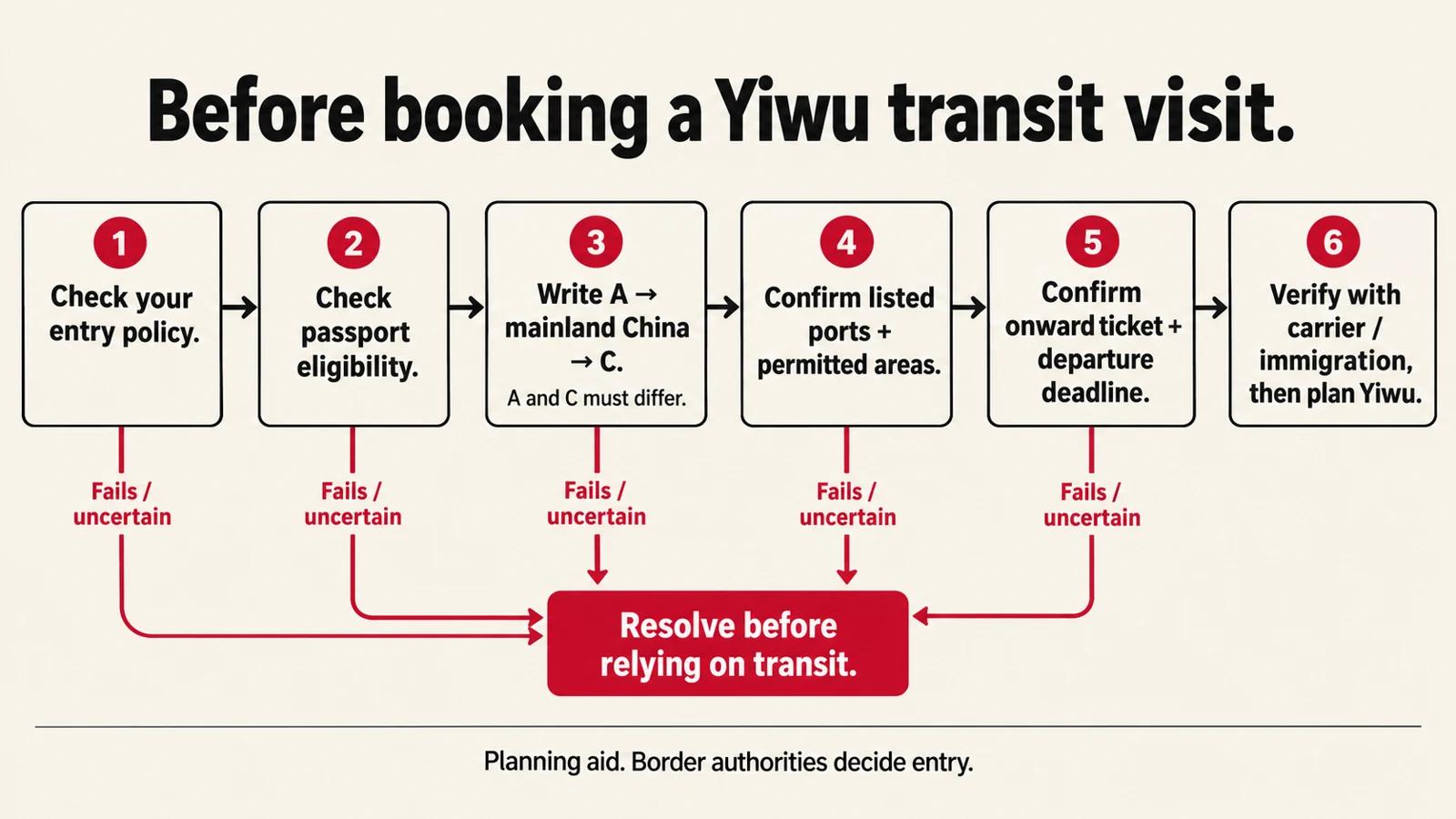
- Check which entry policy applies to you.
- Confirm passport eligibility and onward entry requirements.
- Write the complete A → mainland China → C route and compare A with C.
- Check the actual ports and every permitted stay area.
- Keep confirmed onward travel and a workable departure plan within the deadline.
- Resolve uncertainty with the carrier or immigration, then fit the Yiwu visit around the confirmed boundaries.
For immigration questions, the NIA announcement directs enquiries to 12367. Give the nationality, document type, full flight sectors, dates, ports and intended cities. “Can I visit Yiwu visa-free?” lacks most of the information needed to answer your case. Keep private document numbers out of public comments and general travel-enquiry messages.
After checking the entry route, ask about the Yiwu part of your visit. Send dates, group size, arrival and departure cities, language and the practical question you want to resolve. This sends an enquiry to Justin; availability, service scope and any fees need separate confirmation. It does not reserve transport, issue a ticket or secure immigration approval.
Recheck the plan when something changes
A replacement flight can affect more than the price. Re-run the record if the country or region before or after mainland China changes, the departure date moves, or a different airport or city is added. A new Hangzhou departure may still fit the published geography, but that observation alone does not resolve the complete revised itinerary or any notification requirement in your case. Ask immigration about that point rather than copying a forum reply.
Keep the new confirmed onward evidence and compare the change with the permission you actually received. Do not cancel the journey you are relying on and assume that an unconfirmed replacement is equivalent. Where a carrier and a booking platform show different itineraries, resolve the discrepancy with the operating carrier before travel.
If sudden illness, force majeure or another disruption may require a stay beyond the permitted time or area, the Chinese Embassy in Canada’s guidance says to apply in advance to the local public-security exit-entry administration for a stay document. Contact the responsible office before the limit is reached. A cancelled flight or a hotel extension does not, by itself, amend immigration permission.
Conclusion
Yiwu can be part of a qualifying transit visit because it lies in Zhejiang’s permitted area. The decision starts earlier: your applicable entry policy, passport, full international route, actual ports, onward evidence and deadline must fit together. Complete that record first, then choose how much of the remaining time to spend in Yiwu.
Frequently asked questions
Can I fly into Shanghai and visit Yiwu?
The current permitted-area table includes Shanghai and all of Zhejiang. The rest of your passport, route, port, document and timing conditions must also qualify.
Does a return flight to a different city in the same country count?
No for the third-country route test: the country or region before and after mainland China must differ. Check whether another entry policy applies.
Does the train to Yiwu restart the 240 hours?
No. It is domestic travel within the mainland visit. Use your issued immigration deadline for the whole stay.
Can NiceYiwu confirm my immigration eligibility?
Use the official authorities for that decision. NiceYiwu’s travel enquiry can address practical visit questions; scope and availability require separate confirmation.
Official information checked 26 October 2026. Sources are linked beside the relevant rules. Route and date examples are illustrative; no personal travel or successful-entry experience is claimed.
Research-based guide. Visitor reports are attributed; this article does not imply an in-person test.
Sources & checks
- nia-en full captured body · Checked 2026-10-26
- nia-cn full captured body · Checked 2026-10-26
- nia-conditions full captured body · Checked 2026-10-26
- nia-unilateral full captured body · Checked 2026-10-26
- embassy full captured body · Checked 2026-10-26
- hub full captured body · Checked 2026-10-26
- carrier real web tool capture; carrier direct fetch418 retained separately · Checked 2026-10-26