

Take a same-day Shanghai Hongqiao–Yiwu train only when your airport exit, transfer, station processing and chosen delay margin all fit before that train’s ticket-check cutoff—and a usable ticket is available. Work backwards from the last departure you can actually book for your date. If the calculation fails, arrange a confirmed Shanghai overnight stay and a next-day train instead of treating the airport train’s running time as your whole connection.

This guide helps an international visitor choose an arrival-night plan for Yiwu. All clock times in the worked example are teaching assumptions, not today’s timetable or a minimum connection recommendation. Your flight arrival airport and terminal matter as much as the train you hope to catch. Entry permission must already be resolved separately; this calculation cannot establish immigration eligibility.
 Watch Airport Link transfer context
Independent route overview by AmazingJJ, published August 2025. Its price headline is historical; check current fares and the whole connection budget separately. Playback has not been manually verified.
Start with the right airport and station
Read the airport code on the flight confirmation: PVG is Shanghai Pudong; SHA is Shanghai Hongqiao. Then read the terminal. An itinerary that merely says “Shanghai arrival” hides the largest transfer decision. A Hongqiao arrival avoids the Pudong-to-Hongqiao airport crossing, but it still leaves arrival procedures and the journey from the actual terminal to the railway departure area.
The airport group’s Airport Link information identifies the airport rail stations as Pudong Airport Terminal 1&2 and Hongqiao Airport Terminal 2. The latter name does not mean you have reached your intercity train gate. Follow signs for the railway station and retain a separate allowance for reaching its entrance, completing checks and finding the waiting area. For a Terminal 1 arrival, establish the terminal-to-station route separately; do not copy a Terminal 2 walking estimate.
| Booking or sign | What it identifies | Decision consequence |
|---|---|---|
| Pudong Airport / PVG | Your airport arrival location | Include the cross-city transfer to Hongqiao. |
| Hongqiao Airport T2 | Airport Link endpoint and airport terminal | Keep the onward route to the railway departure hall. |
| Shanghai Hongqiao | The intercity origin used in this guide | Match these words to the paid rail itinerary. |
| Yiwu | The destination station | Arrange the onward journey to your exact hotel. |
Do not rescue a failed connection by silently switching a search from Hongqiao to “all Shanghai stations.” Another station can offer a later train while requiring an entirely different ground journey. Only compare it after replacing the airport transfer and station allowances with the correct route. Likewise, a search result labelled “Pudong to Yiwu” is not proof that the intercity train boards at Pudong Airport: inspect the actual departure station before paying.
Find the last usable train, then count backwards
Use China Railway 12306 for the date-specific Shanghai Hongqiao–Yiwu search. Read the travel date, origin, destination, departure time, arrival time and availability together. “Last usable” means a departure that serves your destination and can be booked for everyone travelling, with an arrival time your Yiwu accommodation can accept. The last row in a general timetable may fail one of those conditions.
Keep the boarding deadline separate from departure. 12306’s passenger guidance says ticket sales and checks stop before departure and directs passengers to station announcements for the applicable advance time. It also identifies potential queues at security, identity verification and ticket gates. There is no universal five-minute rule in this guidance that you should apply to every train or station.
Use this relationship: latest acceptable airport exit = train departure − advance ticket-check cutoff − railway processing allowance − ground-transfer allowance − chosen spare margin. Airport exit means you are through the applicable arrival procedures, have collected any bags and are ready to begin the ground journey. It does not mean touchdown, aircraft doors open or the baggage carousel has started.
- Save the actual date-specific candidate train and check that a usable booking route exists for every passenger.
- Obtain the station’s ticket-check cutoff for that train. If it is still unknown, keep the connection provisional.
- Build the ground journey from your airport terminal to the railway entrance: access, service wait, ride and onward walking.
- Add time for railway entry, identity and security checks, and finding the gate. Increase this allowance for your group’s actual needs.
- Subtract those items and a spare margin from departure. Compare the result with your expected airport exit, then test a delayed version.
Shanghai’s published Airport Link guidance describes about 40 minutes between the two airports. That is a useful ride component, not a landing-to-train estimate. A March 2026 Hongqiao government service update reports a 22:15 final departure from Pudong and 15-minute intervals. A search-indexed version of the airport group page still displays 22:00; direct access to that page failed during this check. Because those official pages differ, verify the current operating notice for your date and direction before relying on a service near closing time. Neither published time tells you when the final Yiwu train leaves.
A road transfer changes the inputs rather than removing uncertainty. Use an actual route estimate and pickup arrangement for that time, then allow for traffic and loading. Do not replace a failed rail budget with an assumed faster taxi. If a proposed private transfer is the only remaining way to reach Yiwu that night, obtain its scope and price before treating it as an alternative.
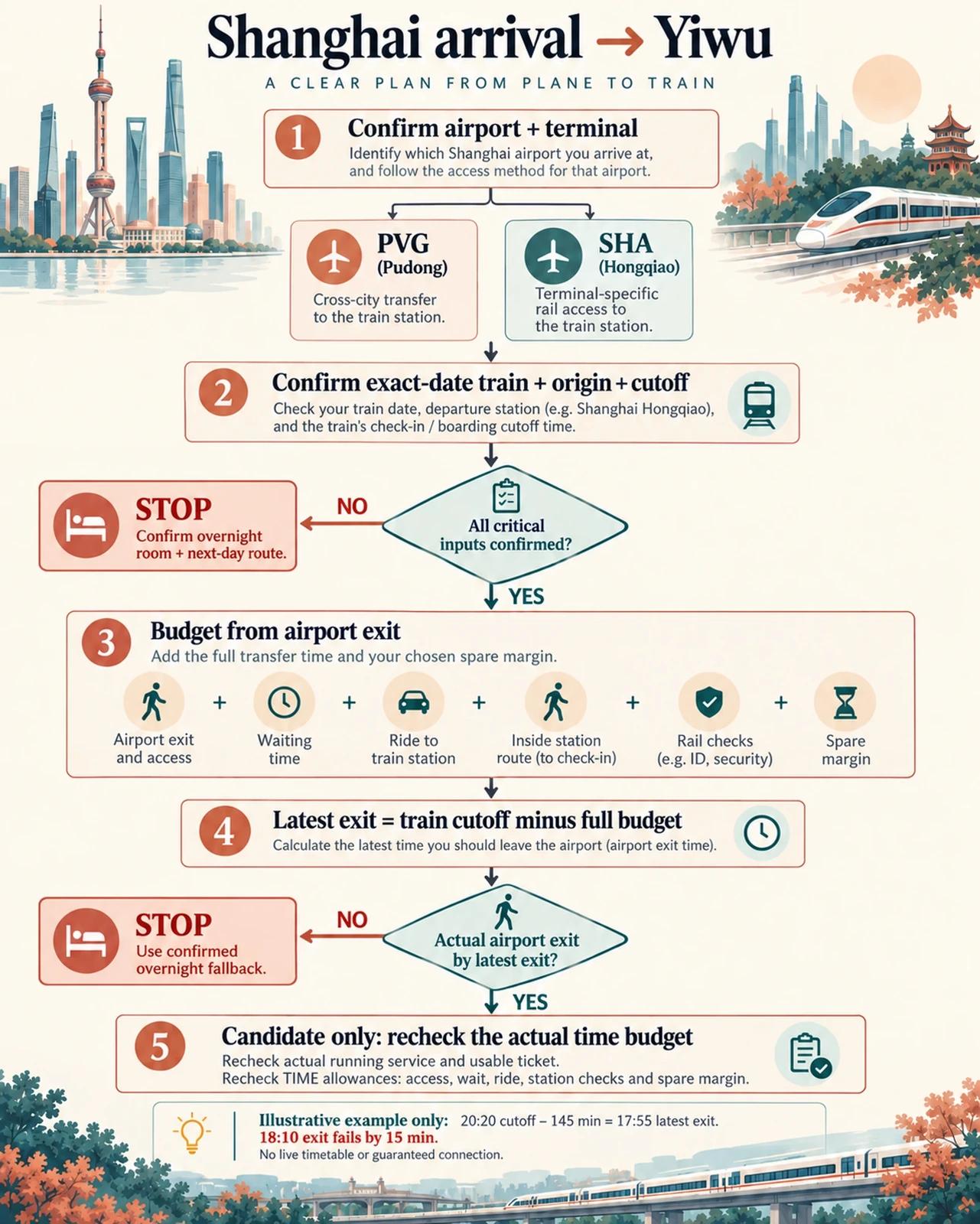
A completed clock budget: why the spare margin matters
Illustrative inputs only: suppose your selected, bookable Hongqiao–Yiwu train departs at 20:30 and its confirmed ticket check closes ten minutes earlier. Assume you expect to leave Pudong arrivals at 18:10. For teaching purposes, allow 15 minutes to reach the Airport Link, 15 minutes waiting, 40 minutes riding, 20 minutes onward to the railway entrance and 35 minutes for railway processing and reaching the gate. Add a separate 20-minute spare margin. Only the roughly 40-minute airport ride reflects published route guidance; all other durations and the train are scenario assumptions.
| Stage | Assumed duration | Clock result |
|---|---|---|
| Leave Pudong arrivals | Starting input | 18:10 |
| Access Airport Link + wait | 15 + 15 minutes | 18:40 |
| Airport Link ride | 40 minutes | 19:20 |
| Reach railway entrance | 20 minutes | 19:40 |
| Railway checks and gate access | 35 minutes | 20:15 |
| Chosen spare margin | 20 minutes | 20:35 required gate deadline |
| Assumed actual ticket-check deadline | 20:30 − 10 minutes | 20:20: budget fails by 15 minutes |
The physical sequence reaches the gate at 20:15, five minutes before the assumed cutoff. That does not meet the traveller’s chosen 20-minute margin. Calling this “enough time” would quietly discard the protection the traveller wanted. The complete budget needs 145 minutes after airport exit; a 20:20 cutoff therefore requires exit by 17:55. With expected exit at 18:10, select an overnight buffer unless a different verified arrangement changes the calculation.
Now change one input. If the same party is actually outside arrivals at 17:40, it is 15 minutes ahead of the 17:55 threshold. The connection becomes a candidate, provided the service is running, tickets remain usable and the allowances are credible. A further 25-minute flight or baggage delay would move exit to 18:05 and make it fail by ten minutes. The rule changes the decision as conditions change; it does not certify the earlier version as safe.
Children, reduced mobility, bulky luggage or unresolved passport booking verification can make the assumed allowances unrealistic. Increase the relevant component rather than burying everything in one optimistic total. A larger spare margin also moves the latest acceptable exit earlier. If you cannot tolerate missing your first Yiwu appointment, an overnight plan can remain preferable even when the arithmetic is positive.
Choose where an overnight buffer belongs
An overnight buffer is a room and a next-day route you can actually use. If you are still at Pudong late at night and have no confirmed cross-city transfer, investigate an airport-area stay first. If you have already reached Hongqiao and have a confirmed morning departure there, a hotel with a verified station route may simplify the next morning. “Near the airport” and “near the railway station” are not interchangeable booking descriptions.
| Your position | Useful overnight candidate | What makes it workable |
|---|---|---|
| At Pudong; transfer uncertain | Pudong-area accommodation | Confirmed late arrival, terminal-to-hotel route, next-day Hongqiao transfer budget. |
| Already at Hongqiao | Accommodation with a verified railway route | Confirmed check-in, morning access and enough time for railway checks. |
| Neither option confirmed | Resolve accommodation before committing onward | Exact property, arrival date/time, passport registration and transport agreed. |
Send the property your real expected check-in time, especially after midnight: ask which night the booking must cover and whether the room will be held. Confirm that it can register your party using the documents you hold, and ask how to reach reception from the actual terminal or station exit. A free shuttle label is insufficient without its pickup point, operating hours and reservation conditions. No specific hotel availability or acceptance has been checked for you in this article.
Then choose a next-day train with the hotel departure, ground route and station checks included. Sleeping near Pudong does not eliminate the cross-city transfer; it moves it to tomorrow. Avoid a very early train if the transport you need cannot reach Hongqiao in time. Compare total costs on the same scope: hotel, local transfers, any rail booking changes and the effect on the first Yiwu night. Unquoted items stay unknown rather than becoming zero.
Finally, tell your Yiwu accommodation when you now expect to arrive. For a leisure itinerary, move the first optional outing rather than trying to recover every lost hour the next morning. The Yiwu travel planning guide is the parent route for arranging the wider visit; use where to stay in Yiwu once the arrival night is settled.
Recheck the decision after landing
Before leaving the airport, replace the estimated exit time with the actual clock time. Check the candidate train again, including the date and exact station, and confirm your next ground service. If the new time is later than your latest acceptable exit, use the overnight branch immediately. A shorter walk or an unusually empty queue may occur, but an arrival plan should not require both to rescue it.
If you hold a ticket that you can no longer use, consult the railway or your booking channel about the rules applying to that order. Do not assume the next train has space, a flight delay guarantees a railway refund, or a later departure uses the same station. Keep any booking change separate from the transport decision: paying for a train does not make an impossible connection feasible.
Keep one concise note accessible offline: flight airport and terminal; actual airport exit time; train date, origin and departure; applicable cutoff; ground route; latest acceptable exit; and the confirmed fallback property’s Chinese name, address and contact. Share the same version with companions so one person is not navigating to the airport terminal while another is searching for a railway gate. This note is more useful on arrival night than several saved generic timetables.
If you want help fitting the arrival into a Yiwu visit, send a travel-planning enquiry with your flight date, airport and terminal, party size, luggage or mobility needs, first fixed appointment and candidate train. Ask whether help is available for your dates and request a written scope before booking. This is an enquiry route; no pickup, hotel room, ticket or connection is guaranteed.
Conclusion
The useful question is whether your whole airport-to-gate chain fits before a specific bookable Yiwu train’s cutoff. Establish the station identity, calculate from airport exit and retain a margin you are willing to use. If the result fails—or critical inputs remain unresolved—confirm an overnight room and next-day route before committing to the cross-city journey.
Frequently asked questions
Is the 40-minute Airport Link ride my whole connection?
No. It covers the airport-to-airport ride. Add arrival formalities, luggage collection, access and waiting, the onward station route, railway checks and your chosen margin.
Can I use the last train time from a general timetable?
Use it to begin research. Check your exact date, departure station, destination, availability and ticket-check deadline before building the connection around it.
Does a Hongqiao Airport arrival remove the need for a buffer?
No. It removes the Pudong cross-city leg, but terminal access, arrival procedures, railway checks and your party’s needs still determine whether the train is feasible.
Should I book the overnight room near Pudong or Hongqiao?
Choose the location you can actually reach that night with confirmed check-in. Then calculate the next morning’s complete route to your booked departure station.
Research-based guide. Visitor reports are attributed; this article does not imply an in-person test.
Sources & checks
- railway · Checked 2026-10-28
- hours · Checked 2026-10-28
- link · Checked 2026-10-28
- hub · Checked 2026-10-28
- Search-indexed airport page only; direct403 and web521 · Checked 2026-10-28