

Test your Dream Valley return from the last usable connection backwards. For your visit date, subtract the park exit, transfer to boarding and a chosen margin from the actual boarding cutoff. If your full show finishes later, change the show or departure plan, confirm another return arrangement, or stay in Hengdian. A show’s advertised start and a train’s final departure do not establish that the complete journey fits.
This is a planning method with a completed illustrative card, not a verified timetable for tonight. The method gives you a latest usable show finish and a clear choice when the numbers fail. Use current, dated information for your own trip; unknown travel time or an unconfirmed pickup stays unknown.
Context video: Day 7: Hengdian World Studios Along the River During the Qingming Festival, Dream Valley — Herlen Travel Diaries. This video does not establish instructions or availability for your own case.
 ▶
Start with the right park and the right return destination
Hengdian is the destination area; Dream Valley is the particular park in this evening plan. The operator’s contact directory identifies Dream Valley as 梦幻谷, 浙江省东阳市横店镇金佛庄路66号. Save that exact name and address rather than a pin for another film set.
The address identifies the park, not your evening exit gate or an agreed driver meeting point. Put the actual gate or pickup location on the route card once established. A driver waiting at a different entrance has not solved the transfer even if both people are technically at Dream Valley.
At the other end, replace “Yiwu” with your hotel’s exact name and address. If a rail journey ends at a station, add the final station-to-hotel leg. If you have a flight or a morning appointment, record that separately; returning somewhere in Yiwu is not the same as reaching the place from which you must start next.
A useful bilingual card therefore has two named endpoints and the connections between them. Show the original Chinese name alongside the saved map pin, without treating an English translation as a different destination. The Yiwu travel planning hub provides the broader visit context.

Collect four date-specific times before booking
The operator publishes a regular programme table, but it explicitly says the daily park notice controls and temporary changes may occur. A regular timetable is a starting reference, not confirmation that your selected show runs at the same time on your date. It also does not establish when you will be ready at a boarding point.
| Input | What to establish for your date | Why it changes the decision |
|---|---|---|
| Show finish | The chosen performance, finish and any exit restrictions | A start time cannot tell you when the transfer can begin |
| Exit allowance | Time from your seat to the actual park exit or meeting point | The station transfer does not start at the theatre seat |
| Transfer and boarding | The route to the correct stop, entry/check-in requirement and boarding cutoff | Reaching the station at departure time can already be too late |
| Last usable connection | Service date, direction, stopping pattern, terminus and final onward leg | A late train that stops short may not complete your return |
Keep each source with the input: a dated park notice, the operator’s current service information, a booking confirmation or a written pickup arrangement. A timetable screenshot without the date, direction or destination is incomplete evidence for this decision.
For the park, use its official Dream Valley page and current visitor-service channels. For each transport leg, establish the service from its operator or actual booking channel. This page does not assert a current last train, a fixed transfer duration or a fare.
Add a margin that reflects your own party and uncertainty. Walking pace, a group regrouping at the exit and finding a pickup point can change what is acceptable. The margin in the example below is an assumption, not a universal recommended number. If an essential leg is still unconfirmed, a positive-looking subtotal cannot make the route confirmed.
Work backwards from the last usable connection
Use one time basis throughout. Write down the boarding cutoff first, then subtract the allowances that must happen before boarding:
Latest usable show finish = boarding cutoff − exit allowance − transfer allowance − chosen margin.
The transfer allowance must include what your route actually needs. Do not count station access twice if it is already included, and do not omit it because a map supplies only a driving time. For a chain of services, test every connection, not just the final departure. The earliest binding constraint controls how late you can leave the show.
Illustrative calculation only: assume a boarding cutoff of 22:15, a 15-minute park exit, a 35-minute transfer allowance and a chosen 15-minute margin. These are invented teaching inputs, not Dream Valley or railway operating times.
Subtracting 65 minutes from 22:15 gives a latest show finish of 21:10. An assumed show ending at 21:20 misses that limit by 10 minutes. Keeping the other assumptions unchanged, an earlier show ending at 21:00 leaves 10 minutes beyond the selected allowances. The choice changes because the finish changes, not because Hengdian suddenly becomes closer to Yiwu.
| Teaching case | Result against latest finish 21:10 | Planning decision |
|---|---|---|
| Full show ends 21:20 | 10 minutes too late | Do not retain this full-show return chain unchanged |
| Alternative show ends 21:00 | 10 minutes remain beyond the assumed allowances | Time budget fits; verify all actual services and terms before committing |
| Transfer duration is unknown | Latest finish cannot be established | Complete the missing route input or choose an independently confirmed alternative |
A positive result means the stated time budget fits. It does not reserve a seat, guarantee traffic or establish that your chosen margin is adequate. A failed result is more decisive: the current assumptions cannot support watching the full show and using that connection.
If a train ends at a different station from the one you expected, rebuild the remaining journey. Do not assume the latest departure reaches every station served earlier in the day. An extra final leg can change both the feasible finish and your fallback.
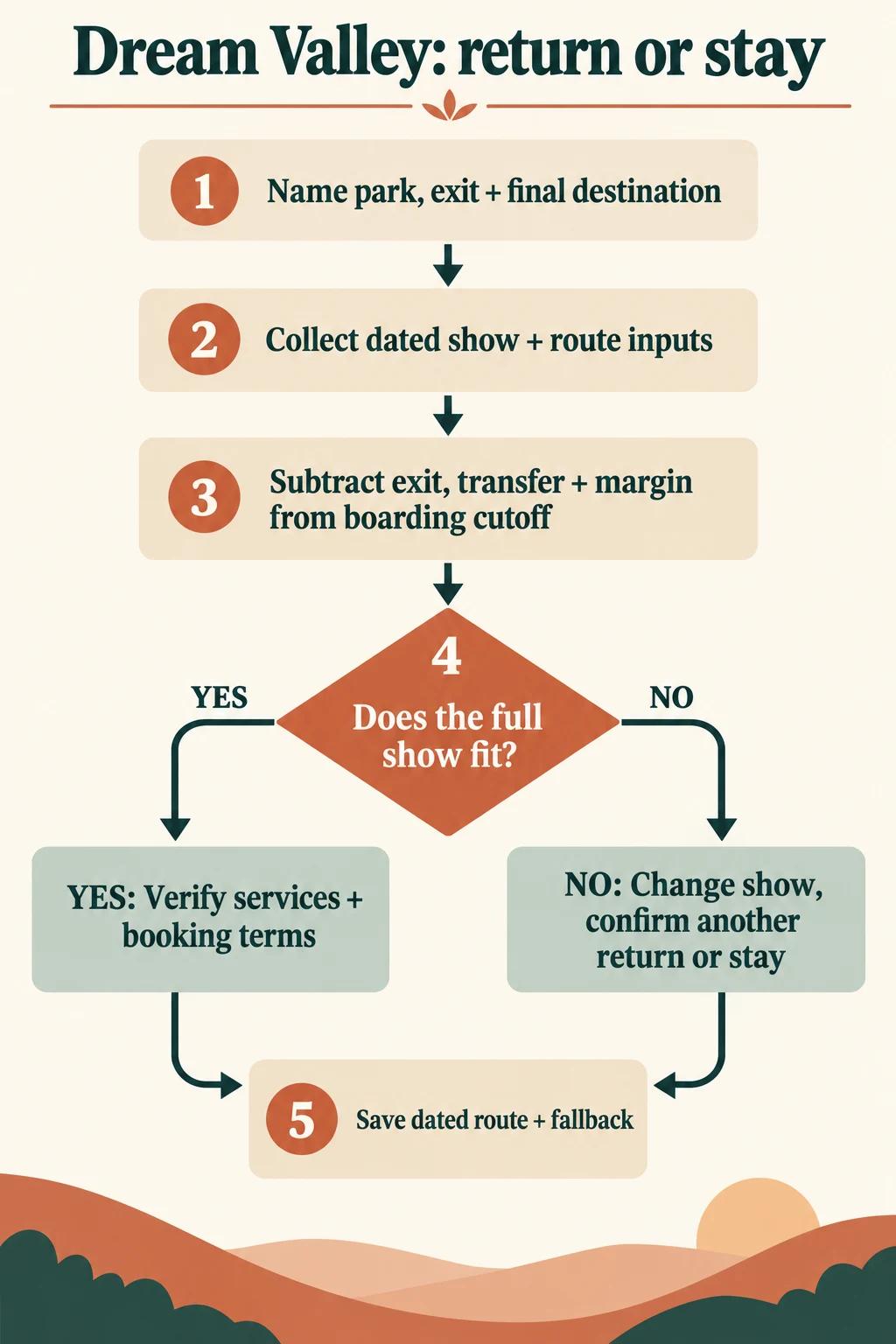
- 1 Name park, exit + final destination
- 2 Collect dated show + route inputs
- 3 Subtract exit, transfer + margin from boarding cutoff
- 4 Does the full show fit?
- YES: Verify services + booking terms
- NO: Change show, confirm another return or stay
- 5 Save dated route + fallback
| Assumed show finish | Latest usable finish | Remaining minutes |
|---|---|---|
| 21:20 | 21:10 | -10 |
| 21:00 | 21:10 | 10 |
Choose what changes when the full show does not fit
Choose the alternative that removes the actual constraint. If an earlier performance finishes within your limit, it may preserve the Yiwu return. If you intend to leave a performance early, first establish whether the show and venue permit the exit you need. Do not build a plan around crossing a closed route or leaving from a gate you cannot use.
A private pickup is a different return arrangement, with its own inputs. Confirm the meeting point, date, pickup window, destination, payment and cancellation terms, and what happens if the show overruns. A ride-hailing app showing vehicles earlier in the day is not the same as a confirmed late pickup. No driver availability is promised here.
An overnight stay removes the need to catch that evening connection, but creates a new arrival and next-morning plan. Check that the accommodation accepts your proposed late arrival and that the actual booking conditions work for your party. Then plan the next day’s journey from that hotel, rather than carrying over the evening transfer assumptions.
Your next-day obligation can reverse the preference. If the evening return fails but a confirmed local stay and morning journey meet your plans, staying is workable. If the morning obligation cannot be met from that stay, change the show or the day trip itself. “Stay overnight” is not automatically a solution to every failed late connection.
Save a return-or-stay card for your visit date
For the failed teaching case, the completed decision is: do not combine the assumed 21:20 finish with the assumed 22:15 boarding cutoff and stated allowances. Choose the earlier-show case only after its actual availability and connection are established; otherwise use a separately confirmed return or an acceptable overnight plan.
Now replace the teaching inputs on a short phone card: visit date; Dream Valley’s exact exit or meeting point; chosen show and confirmed finish; exact final destination; each service and boarding cutoff; exit and transfer allowances; chosen margin; calculated latest finish; and your selected alternative if a required input changes.
Keep the fallback specific. Name the alternative booking or the condition that triggers an earlier departure. Record its cancellation and late-arrival terms. An unconfirmed hotel and an unconfirmed driver do not become a fallback merely because both appear on the card.
Before leaving Yiwu, reopen the sources for your visit date. At the park, compare the day’s notice with the card. If the show or return leg changes, rerun the subtraction and change the decision when necessary. The card is a practical planning aid, not a promise that the evening will follow the example.
Plan your Yiwu travel logistics with your date, party size, intended show and exact return destination. Any requested support needs its own scope and availability confirmation; an enquiry does not book tickets, a room or transport.

Conclusion
Decide the evening by its whole return chain. Establish the right endpoints, work backwards from the last usable boarding cutoff, and compare the result with the show finish. A failed budget calls for a concrete change; a missing input keeps the route provisional. Use the completed example to make that judgment with your own dated information.
Frequently asked questions
Can I plan around the regular show table?
Use it as a reference, then check the daily park notice for your visit. The operator expressly gives that notice priority.
Does the latest train guarantee a return to my Yiwu hotel?
No. Check its direction, stopping pattern and terminus, then include the final leg to your exact destination.
Can I rely on getting a taxi after the show?
This guide confirms no late vehicle availability. A confirmed pickup arrangement needs its own meeting point, timing and terms.