




An order confirmation does not settle a conflicting passport restriction. Ask the exact property to confirm your actual booking in writing; use the booking seller to resolve silence before your cancellation deadline, and choose a separately confirmed alternative when the original remains unusable. A reservation email, a listing badge and a hotel’s ability to complete check-in answer different questions.

This guide is for a visitor already holding a booking, including someone arranging a first night in Yiwu or a wider Zhejiang trip. It does not establish whether a particular hotel has rooms or promise a refund. The choices below are practical applications of official accommodation guidance, not reports of a hotel stay.
Key takeaways
- Match the exact branch and address before deciding that two listings describe the same stay.
- Check the dates, occupants and lead guest on your actual order.
- Ask whether the hotel will receive and register every foreign-passport guest on that reservation; “we have your booking” is an incomplete answer.
- Use your actual booking seller for a reservation problem. Another platform’s hotel page cannot change your existing order.
- Resolve silence before a cancellation cutoff. Do not assume that buying a second room cancels or refunds the first.
 Play: CGTN on hotel “licenses” for foreign travelers
Resolve the exact booking before the deadline
First compare the property’s Chinese name, full street address and branch with your confirmation. A chain name or similar English translation is insufficient. Also check the room dates, number of occupants and who is named as the lead guest. This prevents a genuine passport question from being mixed with a wrong-property or wrong-reservation problem.

Then open the conditions attached to your purchase. Record the latest cancellation time, the time zone shown, whether cancellation incurs a charge, and how to contact the seller. These are inputs to your decision, not universal rules for hotels in China. A refundable room and a prepaid restrictive room require different financial choices even if the front-desk uncertainty is identical.
| Check | Record from your order | Why it matters |
|---|---|---|
| Property | Chinese name, address and branch | Match the exact hotel |
| Guests and stay | Dates, occupants and lead guest | Ask about the whole party |
| Cancellation | Cutoff, time zone and charge | Decide before actual terms change |
| Seller | Contact linked to your purchase | Resolve that reservation |
There is a policy reason to question a blanket foreign-guest restriction. The seven-department accommodation notice says local authorities and online platforms should not use qualification requirements to restrict accommodation operators from receiving overseas guests. It also addresses unlawful published notices refusing overseas guests. That policy does not, by itself, determine the facts of your reservation, create a vacant room or settle the refund terms of an individual dispute.
Keep those questions separate. “What does the policy say?” can be answered from the official notice. “Will this branch check in our party tomorrow?” needs a booking-specific answer. “Who pays if we replace the room?” requires the seller’s terms and response; do not infer it from either of the first two answers.
Ask a question the property can answer
Send the question through the contact channel linked to your reservation or the property’s verified contact details. Give the booking reference, lead guest name, local arrival date and approximate time, party size and the fact that the guests hold foreign passports. Ask the property to confirm all guests, not just the lead name. There is no need to send passport numbers or passport scans with an initial acceptance question.
We have reservation [reference] at [exact branch], under [lead guest name], for [dates]. Our party has [adults and children] travelling on foreign passports. Please confirm that you can receive every guest on this reservation, complete their hotel accommodation registration, and hold the room for our expected arrival at [local date and time]. Another listing shows a guest restriction. Does that restriction affect our actual reservation? Please reply in writing before [our cancellation cutoff].
This is an editorial message you can adapt, not a required official form. Ask separately about the deposit and accepted payment method if those remain unresolved. Prepayment for the room does not tell you what the property will require for a deposit, and an accepted card payment online does not establish what reception can process.
Assess the answer by what it resolves. A response that identifies your branch, reservation and foreign-passport party is useful confirmation. A generic “welcome” or “reservation received” leaves the specific contradiction unanswered. Send one focused follow-up identifying that missing point. If the property cannot answer in your language, ask your booking seller to obtain and relay an unambiguous property response.
The official Travel China hotel check-in guidance lists original passports among accepted registration documents and explains that hotels complete foreign guests’ accommodation registration. Carry the original valid document for each guest, together with the booking details. This guide concerns hotel lodging; a private-home or other non-hotel stay has a different registration process.
Keep, replace or hold provisionally: three choices
The following cases use invented conditions to show the decision. They are not live offers, customer stories or statements about a particular platform’s refund policy.

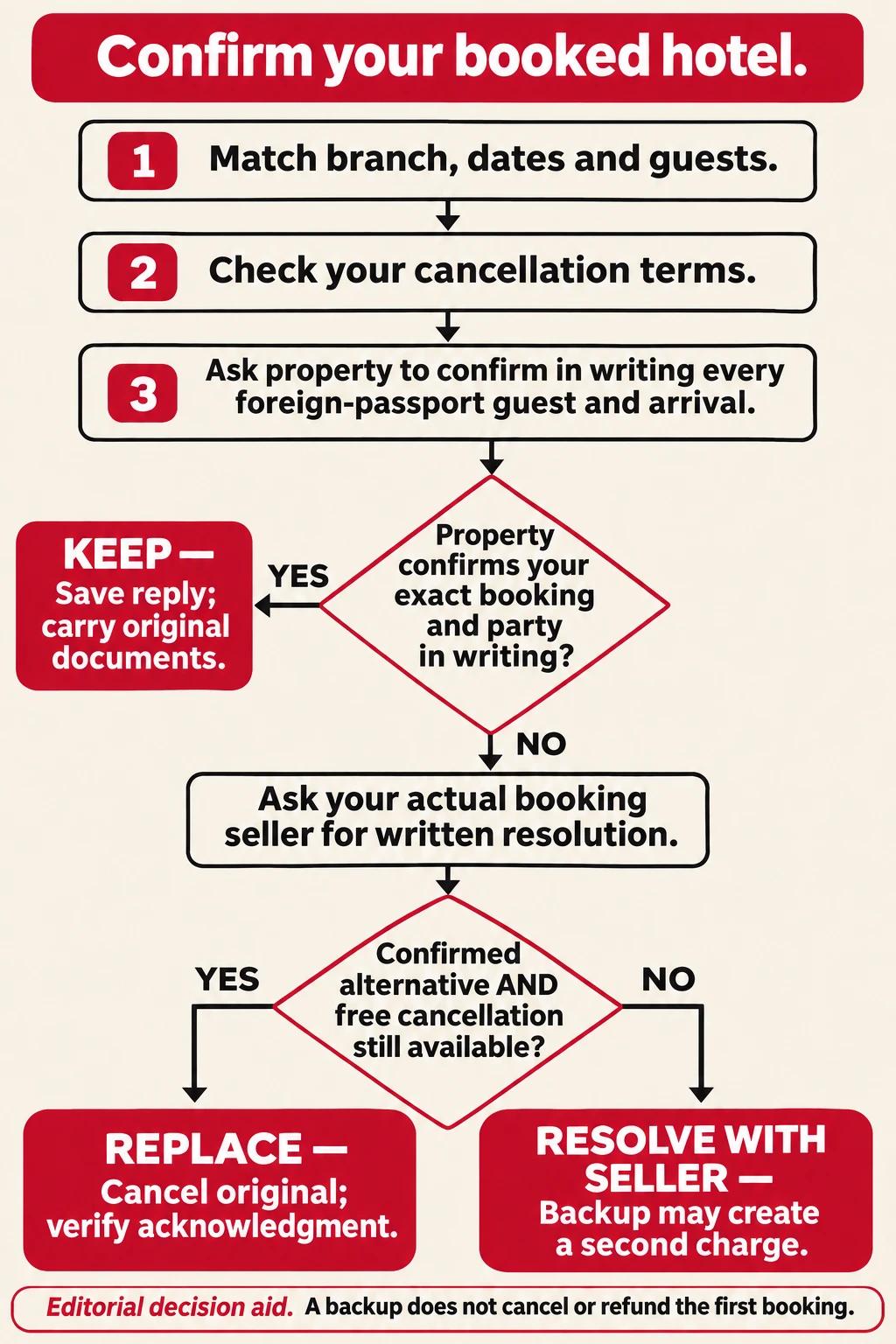
- Match the exact branch, dates and guests.
- Check the cancellation cutoff, time zone and charge in your purchase conditions.
- Ask the property in writing to confirm every foreign-passport guest and arrival.
- If confirmation remains unresolved, ask your actual booking seller for a written resolution before deciding on an alternative.
| Actual conditions assumed for the example | Choice | What remains separate |
|---|---|---|
| The exact property confirms your reservation, every foreign-passport guest and arrival time in writing. Its answer says the conflicting restriction does not apply to this booking. | Keep the booking. Save the reply with the confirmation and property address. Ask the seller to record the resolution if it was involved. | Carry original documents and satisfy the accepted payment and occupancy terms. Confirmation does not eliminate ordinary disruption. |
| The hotel remains silent. Your seller cannot obtain confirmation before the free-cancellation cutoff. A suitable alternative has confirmed your party and dates, and your original terms still permit cancellation without charge. | Use those terms to cancel the unresolved booking and book the confirmed alternative. Save the cancellation acknowledgment. | Check that cancellation actually completed. A message asking a question is not a cancellation. |
| The original booking has restrictive cancellation terms. The hotel has not replied, and the seller is investigating. A backup can be held on separately acceptable cancellation terms. | Ask the seller for a written resolution and any proposed relocation or cancellation remedy. If you choose the backup, treat the original charge as unresolved until the seller confirms otherwise. | A backup reduces accommodation uncertainty but can create a second charge. Compare the backup’s own cutoff and your willingness to carry that risk. |
Changing one condition changes the result. In the second case, if the cancellation cutoff has passed, the assumed free cancellation is unavailable: move to the seller’s resolution process and reassess the cost of replacing the room. In the third case, if the property explicitly declines your party, send that response to the seller immediately rather than continuing to wait for an acceptance that has already been refused.
The useful output is a chosen room arrangement and a clear record of the remaining financial question. It is not a pile of unresolved requests. Set your own decision time early enough to obtain another confirmed room before travelling to it; do not invent a universal response deadline for hotels.
Once the accommodation is resolved, use the Yiwu area and hotel guide to check whether the location suits your actual itinerary. Passport confirmation does not tell you whether the hotel is convenient for your market visits, sightseeing or onward departure.
Plan the rest of your Yiwu visit with your dates, party size, confirmed accommodation area and requested travel help. NiceYiwu’s enquiry is a request for a reply; service scope, availability and fees require separate confirmation. It does not reserve the hotel or resolve a dispute with its seller. Do not include passport numbers in the travel enquiry.
If the problem remains at arrival
Show reception the original documents, booking confirmation and the property’s written reply. Ask staff to check the exact reservation and consult the manager if the passport question remains. Contact the actual booking seller while the issue is current, explaining whether the hotel is refusing the guests, cannot find the order or is reporting a different problem. Those distinctions help the seller investigate the right failure.

Preserve the messages and any written refusal. Ask what the seller is proposing, whether another property has actually accepted your party, who will book it and what charges remain. Do not assume that a suggestion of another hotel includes a confirmed reservation, transport or reimbursement.
If the matter cannot be resolved promptly and you need somewhere to sleep, use an alternative that has confirmed the party, room dates and arrival. Keep the original booking dispute open through its seller’s process. Moving to a room and recovering the first payment are separate outcomes.
The official accommodation notice identifies the 12367 immigration service platform, linked with 12345 government services, as channels for policy consultation and complaints. Use official policy guidance when needed; a complaint channel is not a room booking service and cannot be treated as a guarantee of immediate check-in or a refund.
Conclusion
For an already-booked hotel, the decisive evidence is a clear response about the exact reservation and guests, read alongside the purchase conditions. Keep a properly confirmed stay; replace an unresolved one when the terms and an accepted alternative allow it; and keep any unresolved payment question visible when arranging a backup. This lets you make a practical arrival decision without turning a general accommodation policy into a promise the individual booking has not supplied.
FAQ
Does a “confirmed” order prove that reception will register every guest?
It confirms an order, but it may not resolve a conflicting guest restriction. Ask the exact property to confirm your whole party and address the restriction explicitly.
Should I book through another platform to fix the first reservation?
A new booking is a separate purchase. Resolve, cancel or dispute the original through its actual seller, and check both sets of conditions before holding two rooms.
Can I replace the hotel’s registration with a private-stay online filing?
Hotel lodging is registered by the hotel under the official guidance. Do not switch to a non-hotel process simply because a hotel receptionist is unsure; ask the manager and official authorities for the correct route.
Does the official policy guarantee my refund if a hotel refuses me?
The cited notice does not decide your individual refund. Preserve the refusal and pursue the actual booking terms and appropriate complaint process.
Research-based guide. Visitor reports are attributed; this article does not imply an in-person test.