

A Chinese hospital's direct-billing relationship does not, by itself, confirm that your visit is covered or that you will pay nothing. Match the insurer's written answer to your policy, exact provider, planned service and approval conditions. Then confirm how the hospital will handle that approved scope. If either answer is missing, the payment arrangement remains unresolved.
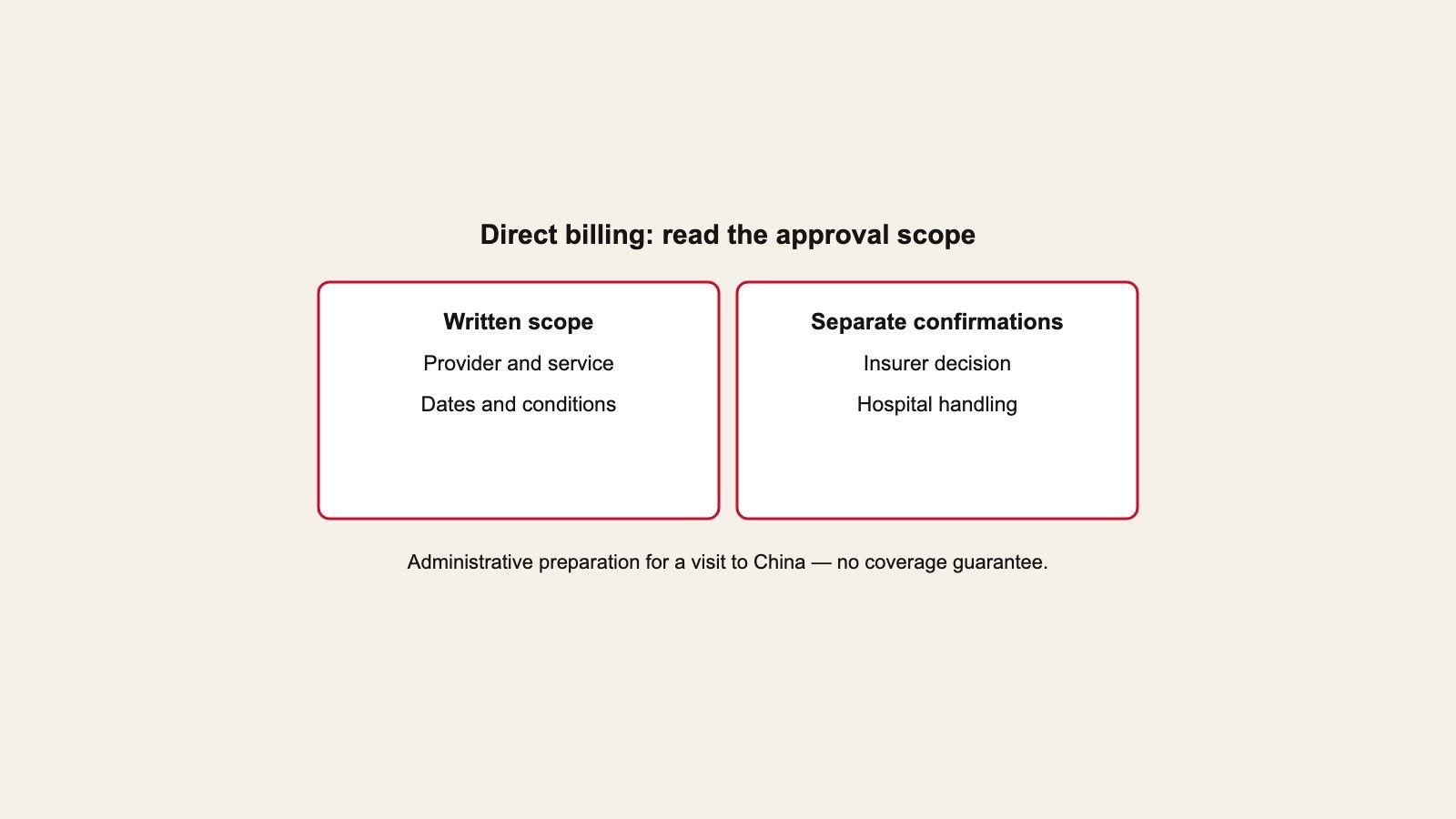
This is an administrative guide for visitors planning a hospital visit in China, including a trip beginning in Yiwu with onward appointments elsewhere. It does not interpret your insurance contract, recommend treatment or promise a cashless visit. Use the medical travel preparation hub for the wider journey.
Key Takeaways
- A hospital network entry, coverage answer and direct-billing arrangement are different records.
- The insurer or administrator answers policy questions; the hospital confirms its billing process.
- Approval for one proposed service does not establish approval for an added service.
- A direct-billing visit can still leave an amount for the patient to pay.
- Keep clinical and insurance documents with the verified hospital or insurer channel, not a travel enquiry.
Video: an insurer’s pre-authorisation explanation
 Watch Bupa Global’s educational video
Bupa Global explains its own pre-authorisation process. It is a provider-specific example, not a rule for your policy or a guarantee about a Chinese hospital. Confirm your insurer’s actual terms; no timing or coverage promise from this video is applied to your visit here.
Watch on YouTube. Manual playback has not been verified.
Separate three answers that can look like one
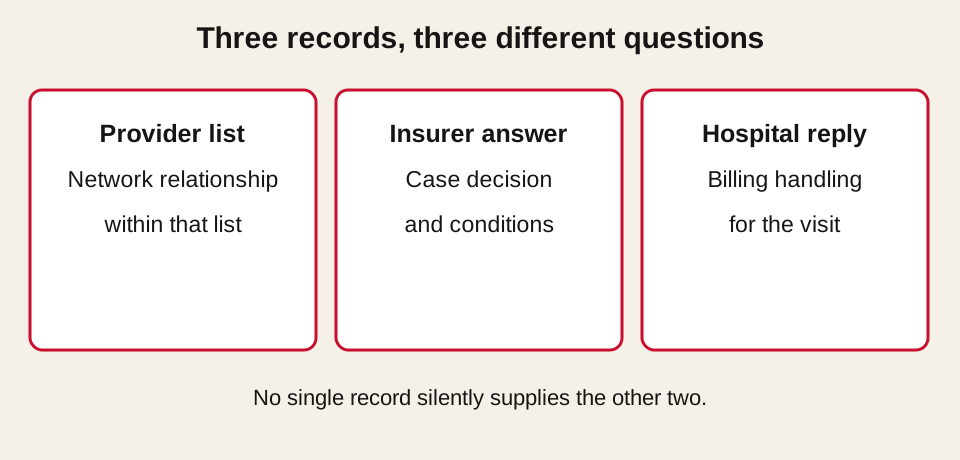
“The hospital takes my insurance” can mean several things. Its name may appear in a provider list. Its billing office may be able to send claims to an administrator. Your insurer may have confirmed coverage for a particular visit. These statements concern different questions, so one should not be used to fill the gaps in another.
United Family Healthcare's insurance page directs patients to facility-specific direct-billing lists and explains that the patient's share depends on the specific plan. Its published arrangements are examples from that provider network; they are not a payment rule for every Chinese hospital. United Family Healthcare: insurance arrangements.
| Record you have | What it can establish | What remains unanswered |
|---|---|---|
| Provider-list entry | A published network relationship within that list's scope | Your policy benefits and approval for the proposed service |
| Insurer's written answer | Its decision and conditions for the case it identifies | Hospital handling of that exact arrangement |
| Hospital billing confirmation | Its stated payment process for the visit | Any policy coverage decision it is not authorised to make |
The practical result is a pair of compatible answers, rather than a collection of logos. For example, a confirmation naming an institution does not necessarily identify its branch or the service you intend to use. Where that distinction affects the arrangement, ask the insurer and provider to resolve it before calling the visit cashless.
Read approval against the proposed visit
Make the comparison using your actual documents. Place the insurer's reply beside the hospital's proposed appointment or service information. Identify the patient and policy, named provider, service or admission, relevant dates, approval status, conditions and the person's payment responsibility. Some answers may not specify every field. An omission remains a question; it is not an invitation to infer a broader approval.
MetLife's published direct-billing guidance makes this separation explicit: its providers are not representatives of MetLife/MSH China and do not determine what the plan covers. It also describes pre-authorisation requirements within its own policy context and warns that some direct-billed charges may remain uncovered. Those particulars must not be copied into another insurer's contract. MetLife/MSH: direct-billing guidance.
An approval reference is useful only with the scope attached to it. “Approved” in an email about an initial consultation does not tell you whether a later admission is included. Likewise, a provider saying it has received an insurance enquiry is not an insurer decision. Retain the original reply and identify who issued it, rather than shortening it into an unsupported “insurance confirmed” label.
Test a change without extending the old answer
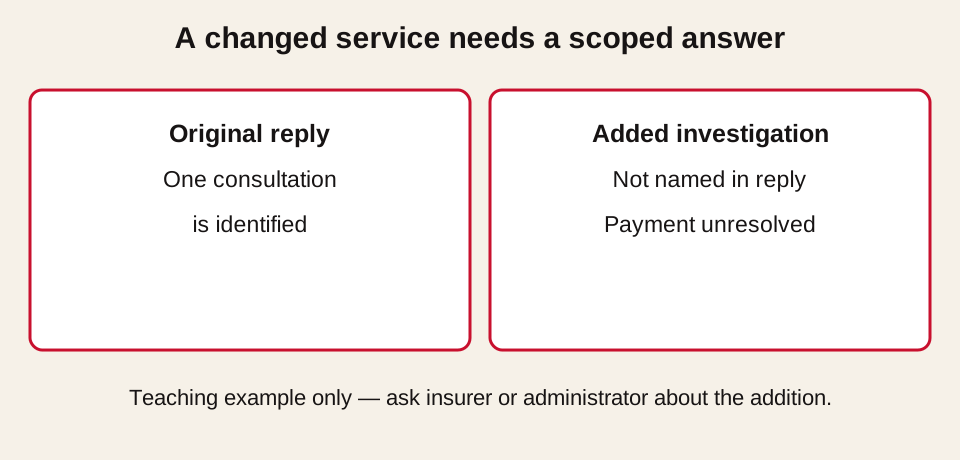
Consider an administrative teaching example, not a patient's case or a model insurer form. A visitor has a written reply identifying one outpatient consultation at a named provider. The hospital then proposes an additional investigation. The consultation answer still says what it said before; the new investigation is not automatically covered by that wording.
The next administrative question is precise: does the existing approval include the added investigation, or must the insurer or administrator issue another decision? The clinical question belongs to the treating team. This guide cannot tell the patient whether to accept or delay care, and urgent care should not wait for a travel-planning enquiry.
Now change the example. Suppose the written answer already identifies both the consultation and that investigation, and the hospital confirms it can apply the arrangement to that visit. The scope mismatch described above is resolved. Any stated limit, patient share, validity condition or later change still needs to be respected. Resolving one missing item does not erase the other conditions.
| Change or missing detail | Administrative result | Specific answer needed |
|---|---|---|
| Added service absent from the reply | Payment route for that addition unconfirmed | Whether existing approval includes it or a new decision is needed |
| Different provider location | Old location cannot silently stand for the new one | Whether the arrangement applies at the new location |
| Hospital has not confirmed handling | Insurer answer exists; hospital process remains pending | Which billing office will apply the confirmed arrangement |
Keep direct billing separate from zero personal payment
Direct billing describes a settlement arrangement. It does not mean every charge is payable under the policy. United Family's page describes co-payments or deductibles, while the MetLife guidance describes circumstances in which a direct-billed claim may not be fully covered. The safe inference is that “the hospital bills the insurer” and “the patient owes nothing” are different propositions.
Ask the insurer to identify the expected patient responsibility under your plan and the hospital to explain when and how that amount is collected. If you may have to pay while a decision is pending, establish the hospital's accepted method and the insurer's reimbursement route separately. Paying first does not itself establish that a claim will succeed; inability to arrange direct billing does not itself establish that reimbursement is excluded.
Keep any uncertain reimbursement conditional when arranging travel. Our non-clinical travel budget guide covers quoted costs, changed dates and cash needed before refunds. This article owns the narrower question of whether the payment confirmation matches the proposed hospital service.
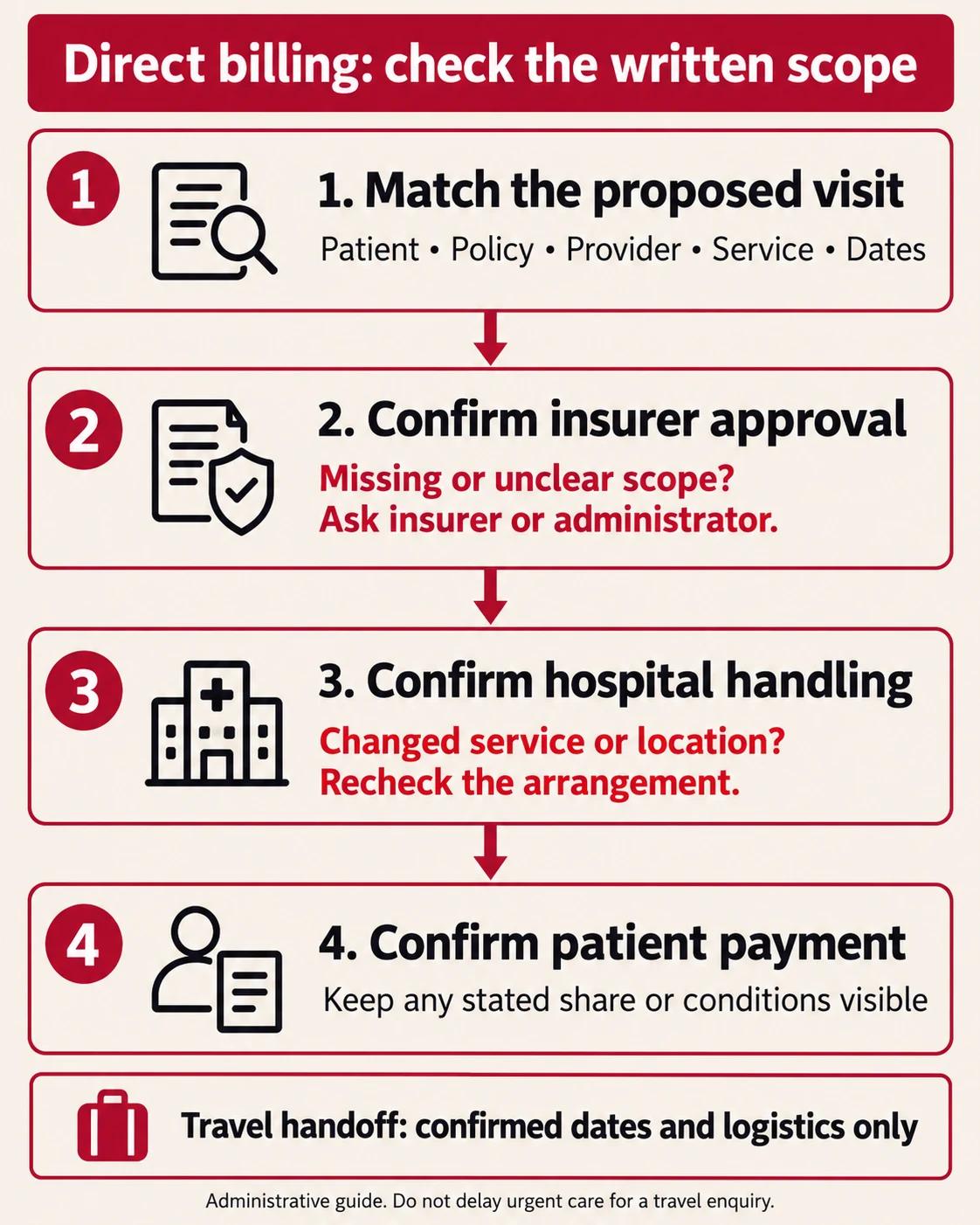
- Match the patient, policy, provider, proposed service and relevant dates to the actual written documents.
- Ask the insurer or administrator to resolve missing or unclear approval scope.
- Confirm hospital billing handling; recheck if the service or provider location changes.
- Confirm any patient payment share or conditions, then use confirmed dates and logistics for travel planning.
Turn the result into a useful travel handoff
Record the confirmed hospital and attendance dates, which payment questions are still pending and which organisation must answer them. A pending insurance answer may affect a nonrefundable travel commitment, but it is not something a hotel, driver or local travel contact can resolve. Keep the original insurer and hospital correspondence in your own records.
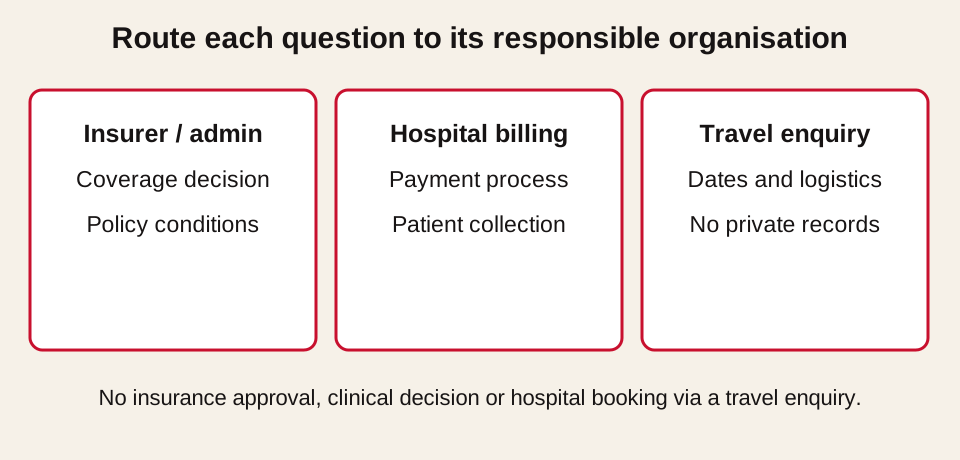
NiceYiwu can receive a practical enquiry about dates, accommodation, transport or language-support arrangements through the medical travel logistics enquiry. Do not include insurance documents, medical records or passport numbers in that form. Availability, scope and any fees need separate confirmation. The enquiry does not obtain insurance approval or book a hospital appointment.
Conclusion
Read a direct-billing answer as a scoped administrative result. Match it to the actual visit, resolve differences with the responsible organisation and keep your personal payment obligations visible. Travel planning can then use confirmed dates and logistics without mistaking a provider list for a coverage guarantee.
FAQ
Is an insurer logo enough?
No. It does not identify your benefits or confirm the proposed service's payment arrangement.
Does consultation approval include every test?
Only the actual approval and policy can establish that. An added service absent from the written scope remains a question for the insurer or administrator.
Does refused direct billing mean no reimbursement?
Not necessarily. Direct settlement and reimbursement are separate arrangements to confirm under your policy.
Can NiceYiwu obtain insurance approval?
The travel enquiry is for practical logistics. Coverage and authorisation decisions belong to the insurer or its authorised administrator.
Research-based guide. Visitor reports are attributed; this article does not imply an in-person test.
Sources & checks
- ufh-insurance · Checked 2026-10-30
- metlife-guide · Checked 2026-10-30
- medical-hub · Checked 2026-10-30
- visit-checklist · Checked 2026-10-30